
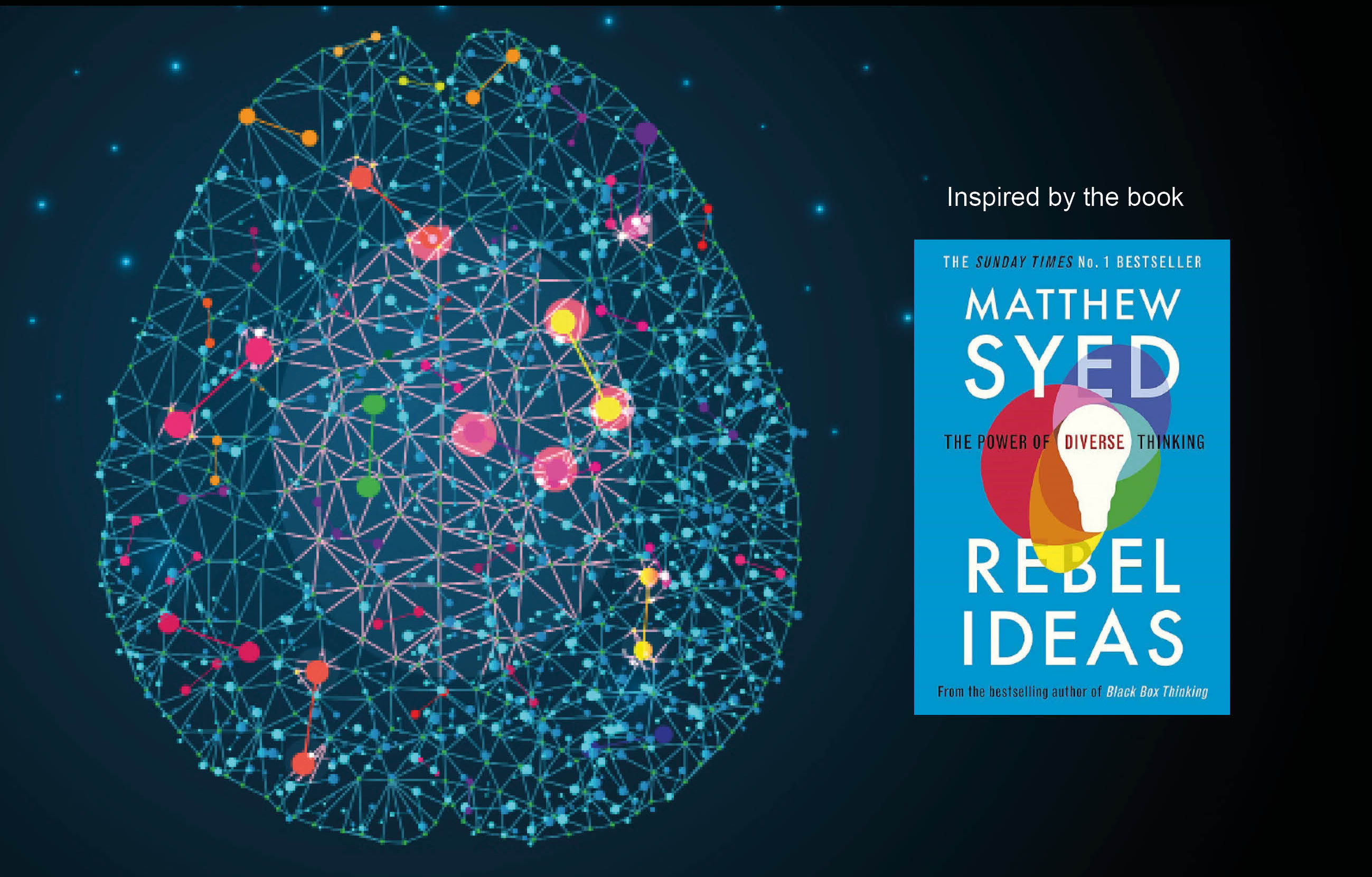
This term, our Teach Meet was inspired by Matthew Syed’s most recent book ‘Rebel Ideas’, specifically the importance of being a Polymath and also why cognitive diversity is so important. Matthew Syed is a British journalist, author, broadcaster and former table tennis player (so quite the polymath himself). He has published several books including; Bounce, Black Box Thinking and Rebel Ideas: The Power of Diverse Thinking in 2019 (with some additions post-COVID). In brief, the book Rebel Ideas argues that diversity in thought and experience is essential for innovation and progress. He draws on examples from various fields, exploring the power of cognitive diversity and the ways in which it can be cultivated in organisations and society. He argues that by embracing difference and creating a culture of respect and safety, individuals and groups can overcome homophily (or echo chambers) and achieve greater success.
The book opens by looking at 9/11 and what retrospectively looked like the failings of the CIA to spot the ‘glaringly obvious’ cues of what was to come. However, the issue wasn’t down to their failings to see what was in front of them, it was down to their failings to diversify the CIA, as since its inception, the CIA had been staffed by ‘white male Protestant elite’. – Collective blindness. The book then looks at what ‘cognitive diversity’ actually means. Cognitive diversity is different from ‘ethnic’ diversity. If you have a group of people from various ethnic backgrounds, who still all went to an Ivy League university, are not diverse in how they think. However, you could argue that their journeys to an Ivy League were very different, so perhaps this is over simplified. Syed’s point is that for cognitive diversity, we need to have a wide range of different thinkers, which is what the CIA was lacking. Its excuse was it only wanted ‘the best’, but this meant they only selected from the same pool. Thus, in the education sector, we need to ensure that there is more diversity in teacher recruitment, in 2021, 85.1% of all teachers in state-funded schools in England were white British, 3.8% of teachers were from the ‘white other’ ethnic group, the second highest percentage, 92.5% of headteachers were white British, 75.7% of teachers were women, and there were more female than male teachers in every ethnic group. The teaching profession is incredibly lacking in diversity, yet how diverse are our school communities? How are we going to reach every student?
Syed also points out that cognitive diversity has a time and a place. When it comes to simple tasks, diversity is a distraction. For example, if you are running a relay (simple task) you just want the best runners. But for complex tasks, such as policy, cognitive diversity is essential. For example, Sweden’s snow clearing policy in the 1970s focused primarily on clearing roads and car lanes, while pavements and bicycle lanes were left covered in snow and ice. Women, who tended to walk more than men and were more likely to be responsible for taking children to school and running errands, were disproportionately affected by this policy. These examples highlight the importance of considering diverse perspectives when deciding on complex policies. Thinking about this in education, it is why we are seeing even more emphasis (and rightly so) on the importance of staff/student/parent voice in individual schools. In the education sector, we are very much working on ‘complex’ tasks and so cognitive diversity is important. Yet, if we look at the past ten years of Secretaries of State for Education, where we have had ten different people, is there really much diversity in their experience or thought…?
This is very much a ‘whistle stop’ tour of the book, but it leads me onto the two main themes and chapters I wanted to focus on from Rebel Ideas: Innovation and Beyond Averages.
Innovation
Syed looks at the two types of innovation, incremental and recombinant.
- Incremental innovation – James Dyson (vacuum) and the understanding of the cyclone systems with each new version.
- Recombinant innovation – take two ideas (previously unrelated) and join them together e.g wheels and suitcases… Matt Ridley calls it ‘ideas having sex’.
Recombination needs diversity as it is bringing together different fields – rebel combinations. A study in 2017 revealed that 43% of companies in the Fortune 500 were founded or co-founded by immigrants or the children of immigrants. Another study found that around a quarter of all tech and engineering companies started in the US from 2006-2012 had at least one immigrant co-founder. So why is this? When immigrants see a tech company in a new country, they do not see it as something set in stone, but rather something that could be changed, reformed or adapted (this is called the ‘outsider mindset’). Immigrants also have experience of two different cultures (recombination innovation). Therefore they can be a lot more creative and able to think outside the box. Could we make parallels to the teaching profession and COVID-19 pandemic? Were teachers who tend to be more traditional in their teaching less able to adapt whereas those who were newer to the field, thus technically having an ‘outsider mindset’ more able to adapt?
To have an ‘outsider mindset’ you do not just have to travel across borders, it is about interdisciplinary skills or being a polymath. Darwin alternated research between zoology, psychology, botany and geology which enhanced his creative potential as it gave him the opportunity to see his subject from the outside and fuse ideas from diverse branches of science. One study found that the most consistently original scientists switched topics, on average, a remarkable forty-three times. Think of the original philosophers, they were artists, mathematicians and scientists. When comparing the Nobel Prize winning scientist with other scientists from the same era, the nobel laureates were twice as likely to play a musical instrument, seven times more likely to draw, paint or sculpt, twelve times more likely to write poetry, plays or popular books and twenty two times more likely to perform at amateur acting, dancing or magic. Similar results were found for entrepreneurs and inventors. Therefore what we need is not necessarily to be ‘experts’ but to have ‘conceptual distance’, being deep and too focused in our areas of study limits us. We do still need inside expertise: we need conceptual natives and recombination immigrants working together. Ultimately, most institutions need specialists who in turn, need space to do their job. But we often get the balance wrong, leaning towards insularity and ‘expertise’, not because we don’t value the insights of people who think differently, but because we underestimate their significance, like the CIA did. Again, how many meetings have we been in when staff only want to work in their departments or don’t see how something applies to their subject?
Provocation one: Are teachers (and the education system) too focused on being ‘experts’? How can we inspire innovation in the classroom?
Firstly, one of the reasons why teachers perhaps focus ‘too much’ on being experts is down to the fact that the system we are in doesn’t favour the polymath. Exam specifications are bigger and more content heavy than ever since the 2016 reforms. As Syed points out, being an expert is important. For teachers, it allows them to have a deep understanding of their subject area, which in turn enables them to design and deliver effective lessons. At the same time, polymathic thinking is also valuable for teachers. Being a polymath can allow teachers to make connections between different fields of study and to bring a diverse range of perspectives to their teaching practice. Ultimately, being a successful teacher requires a combination of expertise and polymathic thinking. Teachers need to have a deep understanding of their subject area, but they also need to be able to think creatively and make connections across different fields of study. By incorporating both expertise and polymathic thinking into their teaching practice, teachers can create engaging and effective learning experiences for their students. Surely this is more meaningful for our students and their future skill set than teaching to the exam?
That being said, many subjects do naturally have interdisciplinary elements, such as Science and Modern Foreign Languages. Science is a multidisciplinary field that encompasses a wide range of subjects, including Mathematics, Physics, Chemistry, and Biology. It requires the ability to think critically, logically, and creatively, and to analyse and interpret data. Therefore studying science can help students develop problem-solving and analytical skills, which are essential for developing a polymathic mindset. MFL requires students to learn a new language and to gain an understanding of different cultures. This requires developing an open-minded and empathetic approach to communication and a willingness to learn and adapt to new ways of thinking and communicating. Studying MFL can help students develop a broader perspective on the world and an appreciation for different ways of life. Thus, science and MFL share many similarities in their approach to inquiry and investigation. Both subjects require an evidence-based approach and the ability to question assumptions and evaluate evidence. They both require creativity and adaptability to different contexts, and they both involve developing a deep understanding of complex systems. By studying science and MFL, students can develop a range of skills and knowledge that can help them become more well-rounded and adaptable individuals, capable of approaching problems from multiple perspectives and finding innovative solutions. This can help them become polymaths, with the ability to integrate different fields of knowledge and use their diverse skills and perspectives to make valuable contributions to society.
Finally, as teachers we can support and model being a polymath in our approach to teaching and learning. Lesson study is one such way. Lesson study is a collaborative process in which teachers work together to plan, observe, analyse, and refine a single lesson or unit of instruction. The goal of lesson study is to improve teaching and learning by focusing on the process of lesson design and delivery, rather than on individual teacher performance. This allows teachers to observe lessons from across departments and thus modelling being a polymath. Within our actual lessons, one idea to encourage this interdisciplinary thinking is by using starters of ‘what connects’ or dual coding to get students thinking in a recombinant way.
Beyond average
So the next chapter I wanted to focus on was ‘Beyond Average’ which specifically looks at why ‘standardising’ anything (including education and policy) doesn’t work. One example it gives is the American airforce during the late 1940’s and their incredibly high crash rates. He discusses the issue with the design of aeroplane cockpits which is based on a ‘mythical average’. This is similar to some of the issues raised in the book; Invisible Women by Criado Perez, which talks more about the ‘tyranny of average’. For Example, piano keys were designed based on the average hand size of men as well as other things such as military equipment. Averages discriminate. Syed then looks at how we use ‘averages’ or ‘standardised’ concepts in other workplaces and how this impacts people’s creativity and success.
Syed looked at the success of call centre employees, he found that those who used Chrome or Firefox were more productive, more successful, more likely to stay longer, less absences etc than those who use internet explorer or safari. But, why? Explorer or safari come as standard on a PC or Mac. To use Chrome or Firefox, you have to be curious enough to see if there are better options out there, you have to download and install them. Therefore these are the type of employees that don’t stick to scripts that call centres often provide for its employees, they think outside the box and problem solve. They don’t keep to the ‘standard’ script. This idea also applies to standardised work spaces. Syed compared standardised or ‘lean’ office spaces (this the same cubicle for all) to those who give people autonomy to create their own space. In these autonomous spaces productivity rose by 30% from the ‘lean’/standardised spaces. Furthermore, there is a correlation between job satisfaction and creativity: those who saw their roles as what they wanted them to be, rather than just a standardised job description that they must fulfil, were more successful and creative. This is why we cannot standardise the workforce. In fact the most important working requirement of Generation Y is flexibility and work life balance. So, if we know the work force we are setting our students up for shouldn’t be standardised, why do we continue to standardise education? Especially when this is potentially so detrimental and not preparing students for the workforce?
Continuing to look at this from an educational perspective, the 2015 PISA tables showed that ‘adaptive instruction’ was the second most powerful predictor of high levels of educational outcome, rating above discipline, class size and much more. The only thing more powerful was wealth. Adaptive instruction is teachers who adapt to the needs of individual students rather than getting everyone to do the same thing, at the same pace, at the same time. What we should be working towards is an education system that flexes to the needs of individual learners, yet we are told to crowbar individuals into a standardised system. We give students very little autonomy over their learning experiences. We ask them to take standardised tests when they arrive at school and continue to use these as measures of their progress. They will then all sit the same test at the end of Year 11 and Year 13, which is standardised by an external exam board. Do these exams allow students to be creative and to be polymaths? Think about the EBacc which gives superiority to certain, and not traditionally creative, subjects.
Provocation two: Do standardised tests still have a place in education? What do they actually tell us?
Some staff who have recently been on exam board training reported that change is coming, however, what this is and what it will look like is unknown. However, with our first summer of ‘normal’ exams since COVID just around the corner and the more recent ‘tech revolution’ in the form of Chat GPT, let’s hope the appetite for change in how we assess students continues.
Another interesting point is that there appears to be an increase in applications to American Universities. The American higher education system has a long-standing tradition of liberal arts education, which emphasises a broad-based education in the humanities, social sciences, and natural sciences. This approach is different from the more specialised degree programs that are common in the UK and many other countries. For context, there were over a million international students studying in the United States in the 2019/20 academic year. This is compared to 690,923 ten years earlier.
This then led us to consider whether we think our students would rather be polymaths or experts? As, although we may know the benefits of being a polymath, what if that does not resonate with our students? Unfortunately, the feeling is that a lot of our students are still pressurised by the ‘perception’ of certain routes in education. Again, the precedence of EBACC in the state sector and the reputation of Oxbridge and Russell group universities continues to push a very narrow narrative of what education and ultimately, what intelligence looks like. Coming back to ‘cognitive diversity’ and the importance of breadth of knowledge, not just depth of knowledge, we can see that standardising anything encourages a specific ‘blinkered’ knowledge that is not broad and this in turn does not support creativity or innovation. Which certainly seems to be an issue in our current education system.
Conclusions
To finish on a more positive note, Syed ultimately asks ‘why are humans so successful?’ We may be inclined to think ‘big brains lead to big ideas’ but the reality is that it’s more like ‘big ideas lead to big brains’. Diversity (and being social) is the hidden gem of humanity and perhaps natural selection will start to favour good learners. The reason only humans evolved is we are social. In groups such as Chimpanzees, they have one dominant male and a few females, this dominance ‘stops creativity’. In orangutans, they are isolated creatures. Therefore, innovation dies with them. It is not that they are ‘less intelligent’, they are just collectively less intelligent. Humans are not different from animals because of our hardwear (genetics) but because of our collective brains.
So what practical advice can we take from Syed on how we can harness diversity?
- Unconscious bias: We need to do what we can to address and be aware of our unconscious bias.
This isn’t ‘easy’ as it is unconscious, however if left unchecked, this becomes structural bias and is dangerous. Syed looks at how orchestras introduced recruiting with a screen, so they could hear the music and not see the candidate. When this was introduced, female players increased from 5% to 40%
A university study looked at CVS. When a black candidate was clearly better than a white one, they would choose the black candidate. And vice-versa. However, when the applications were close, that is when unconscious bias crept in and students showed a preference for white candidates.
Unconscious bias becomes structural bias: those who are less likely to be selected have to work even harder, and the incentive to work harder is not there. As educators, we need to empower our students to feel that they can break through any barriers that structural bias brings as well as being empowered to recognise and challenge bias.
Interestingly, in the GDST ‘The Girls’ Futures Report 2022, it looks at how girls’ confidence dips in teenage years, some of this is down to biological changes but some of this is also down to the structural bias of society and how it specifically ‘nurtures’ girls. Yet, in the GDST context, our girls do not feel held back compared to those in co-ed and their confidence is similar to boys in co-ed schools. So although this is a less diverse environment in terms of sex, the positive impact of these environments is that the educators who work in this context are working even harder to ensure that their students do not feel that conscious or structural bias is going to negatively impact their futures.
- Shadow boards: young people who advise executives on key decisions and strategies. These typically consist of a group of the most able young people, drawn from across an organisation (therefore with a variety of experience/expertise), who have regular input into high level decision making.
Again, we could use this as a way of practising student/staff and parent voice – ensuring that we are getting insight from a range of our stakeholders with a variety of lived experiences.
- A giving attitude: in a study of 600 medical students, they looked at the success of the givers vs the takers. In the first year, where their practice was very individual, the takers outperformed the givers. However, in the second year, where their placements were more collaborative, the givers caught up to the takers. By the third and fourth year, the givers were outperforming the takers significantly.
As educators, I think we are by nature, really giving. This is something that we should continue to role model to our students and society.
So in a very simple conclusion; embrace diversity and challenge bias, embrace the polymaths and challenge the ‘experts’, embrace being social and challenge the echo chambers. We can learn a lot, we can achieve a lot.
References
Matthew Syed, Rebel Ideas: The power of diverse thinking, 2019
The Girls’ Futures Report 2022
School teacher workforce – GOV.UK Ethnicity facts and figures
 This Teacher Blogs
wow!! 27Making space for learning: Establishing a school makerspace
LikeLike