A way to share reflections on educational research, teaching and learning. #teaching #education #learning #edtech #innovation #cognitivescience #iteachtoo
As the digital landscape continues to shift beneath our feet, one thing is increasingly clear: artificial intelligence isn’t a fad, it’s a future-defining force. For educators, the challenge is no longer whether to engage with AI, but how. And for our students, it’s not just about learning with AI, it’s about learning how to think alongside it.
The world of work our pupils will inherit is rapidly changing. McKinsey & Company (2023) forecast that automation and AI could displace up to 30% of current work activities by 2030. But rather than AI replacing humans outright, we’re seeing the emergence of the “Centaur” and “Cyborg” models of productivity. In a Centaur model, humans and AI work together; the human leads, the AI supports. In the Cyborg model, the lines blur; AI tools are embedded in how we operate (Shneiderman, B., 2022). While both have merit, it’s the Centaur that offers students the greatest opportunity to thrive, be thoughtful, creative, and in control.
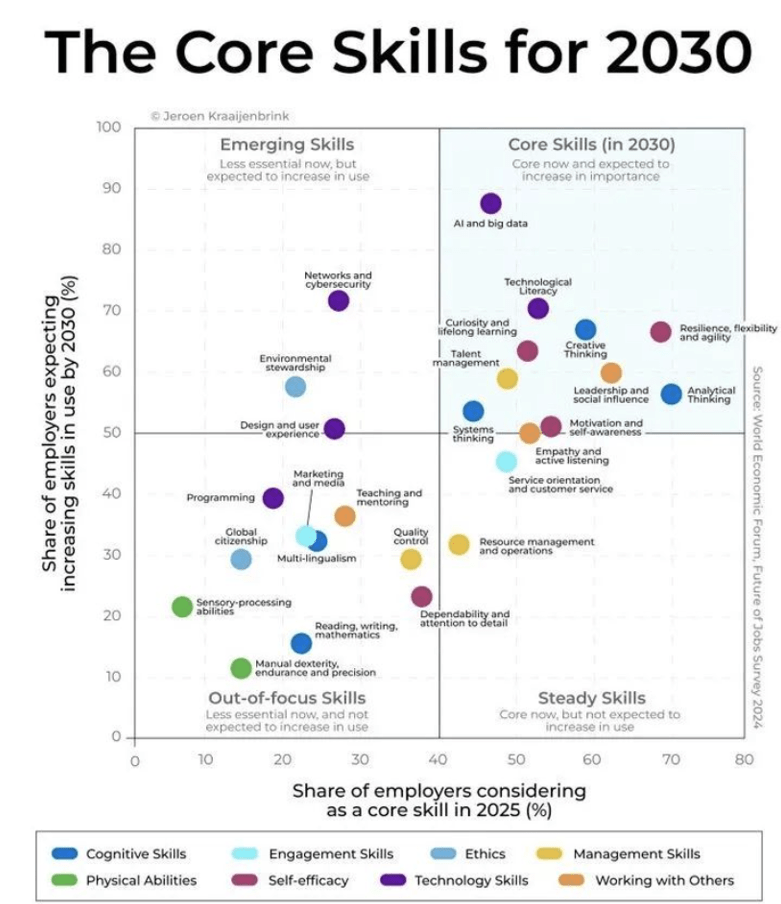
This distinction matters. As educators, our job is to prepare students not just to use AI tools, but to collaborate with them ethically and intelligently. That’s why our latest CPD offering focused on helping staff meaningfully integrate AI into lessons; not as a gimmick, but as a way to enhance understanding, boost creativity, and promote critical engagement. Not to mention, ensuring that our students have the core skills required for the future, as highlighted by the Worlds Economic Forum, Future of Jobs Survey 2024.
This is why at Berkhamsted, we have designed age-appropriate AI tasks for students engage with that are grounded in evidence-informed principles to support high-impact learning. Core principles such as retrieval practice, metacognition, critical thinking, student voice and self-efficacy were all incorporated into tasks and AI prompts. These were then shared with staff and trialled in various subjects from Year 7 to Year 13. The reach and flexibility of AI enables students to take the lead in shaping their learning, becoming Centaurs as they utilise AI for support.
As Shneiderman (2022) argues in Human-Centred AI, it’s the Centaur approach that best supports ethical, responsible, and cognitively rich engagement with technology, particularly in education. And Kasparov (2017) reminds us that in chess, the best outcomes didn’t come from AI or humans alone, but from Centaur pairings of both. The activities we designed weren’t created for AI, they were created for students. AI just makes them more dynamic.
Teaching students to be Centaurs, not passive recipients of machine output, but thoughtful collaborators, is our moral imperative. This doesn’t begin with grand declarations, but with lesson plans, with prompts, with playful experimentation.
So, start small. Start with curiosity. Start with evidence-informed pedagogy. And most of all, start with students.
References
Abrami, P. C., Bernard, R. M., Borokhovski, E., Waddington, D. I., Wade, C. A., & Persson, T. (2015). Strategies for Teaching Students to Think Critically: A Meta-Analysis. Review of Educational Research, 85(2), 275–314.
Agarwal, P. K., & Bain, P. M. (2021). Powerful Teaching: Unleash the Science of Learning. Jossey-Bass.
Bandura, A. (1997). Self-Efficacy: The Exercise of Control. Freeman.
Education Endowment Foundation. (2018). Metacognition and Self-Regulated Learning.
Kasparov, G. (2017). Deep Thinking: Where Machine Intelligence Ends and Human Creativity Begins. John Murray.
McKinsey & Company. (2023). The State of AI in 2023: Generative AI’s breakout year.
Mitra, D. L. (2004). The Significance of Students: Can Increasing “Student Voice” in Schools Lead to Gains in Youth Development?Teachers College Record, 106(4), 651–688.
Shneiderman, B. (2022). Human-Centered AI. Oxford University Press.
Teaching is both an art and a science, and few frameworks articulate this better than Rosenshine’s Principles of Instruction. These ten research-backed principles provide a blueprint for effective teaching, focusing on elements such as scaffolding, questioning, and regular review. While they have long been a staple of high-quality instruction, integrating AI into how we further embed these elements provides an opportunity to enhance their impact and save teachers planning time. In this blog, I’ll explore why Rosenshine’s Principles remain so important and how AI can help teachers embed them into daily practice.
Why Rosenshine’s Principles Matter
Rosenshine’s framework is rooted in decades of research into how students learn best. His work draws from observational studies of the most effective teachers (Rosenshine, 2012), cognitive load theory (Sweller, 1988), and the science of retrieval practice (Agarwal & Bain, 2019). At its core, it highlights the importance of breaking down new learning into manageable steps, ensuring students aren’t overwhelmed by cognitive overload. This approach aligns closely with Vygotsky’s (1978) Zone of Proximal Development, where learners benefit from guided instruction before gradually moving towards independence. It also reinforces what we know about the power of retrieval practice, regularly recalling and applying knowledge strengthens memory and prevents forgetting (Roediger & Karpicke, 2006). Effective questioning is another key element, helping to diagnose misconceptions early and deepen student understanding, an idea supported by Black and Wiliam’s (1998) work on formative assessment. In short, Rosenshine’s principles are not just a teaching framework; they’re a synthesis of what cognitive science tells us about effective learning. The challenge, of course, is making them happen consistently in the classroom. This is where AI can play a crucial role; acting as a tool to support, streamline, and enhance these evidence–based strategies, rather than replacing the human connection at the heart of great teaching.
Harnessing AI to Support Rosenshine’s Principles
Principle
Research
Prompts for AI
Daily review
The most effective teachers in the studies of classroom instruction understood the importance of retrieval practice, and they began their lessons with a five- to eight-minute review of previously covered material. Effective teacher activities also included reviewing the concepts and skills that were necessary to do the homework, having students correct each others’ papers, and asking about points on which the students had difficulty or made errors. Effective teachers also reviewed the knowledge and concepts that were relevant for that day’s lesson.
Create a multiple choice quiz on … Act as a knowledgeable Year … Religious Studies teacher who is an expert at reviewing previous learning. The quiz should be 10 questions long, have 4 possible answers and the correct answer identified. I would like the questions to get progressively more difficult but be written for the reading age of … year old.
New material in small steps
Our working memory, the place where we process information, is small. It can only handle a few bits of information at once—too much information swamps our working memory. Presenting too much material at once may confuse students because their working memory will be unable to process it. Some successful teachers taught by giving a series of short presentations using many examples. The examples provided concrete learning and elaboration that were useful for processing new material.
Create 4 tasks that will chunk the topic of … You are an experienced Religious Studies teacher, you know the importance of scaffolding tasks for your students. You are teaching … and many students are struggling with … Can you create a bank of tasks which chunks this topic into smaller more manageable parts. Are there underrepresented voices on this topic I can include?
Ask questions
Students need to practise new material. The teacher’s questions and student discussion are a major way of providing this necessary practice. The most successful teachers in these studies spent more than half of the class time lecturing, demonstrating, and asking questions. Questions allow a teacher to determine how well the material has been learned and whether there is a need for additional instruction. The most effective teachers also ask students to explain the process they used to answer the question, to explain how the answer was found. Dylan Wiliam – Hinge Questions
Create a sequence of hinge questions on the topic of.. Act as an experienced secondary Religious Studies teacher who is an expert in accessing students knowledge before moving on. You are well versed in Dylan Wiliam’s ‘hinge questions’. Create a set of hinge questions for … I would like the questions to get progressively more difficult but be written for the reading age of … year old. I would also like a bank of possible misconceptions within this topic. Are there underrepresented voices on this topic that I can include?
Provide models
Students need cognitive support to help them learn to solve problems. The teacher modelling and thinking aloud while demonstrating how to solve a problem are examples of effective cognitive support. Worked examples (such as a maths problem for which the teacher not only has provided the solution but has clearly laid out each step) are another form of modelling that has been developed by researchers.
Create a model of a GCSE Religious Studies exam answer to … You are an experienced Religious Studies teacher, you know the importance of modelling tasks for your students. You are teaching … and need to guide them through the process of writing an extended answer. Can you create a model answer, with questions to check knowledge, understanding and clarity at various points through the answer. The model should be written at a reading level of 15 years old. OR You are going to act as the teacher, modelling and showing how you have problem solved the answer to this question. You are an expert in Rosenshine’s principles of instruction and know the importance of providing models. I am a Year 10 Religious Studies student studying … . How should I answer this 12 mark question: … This is the mark scheme and/or assessment criteria: I would like you to pause and explain your workings out. I would also like you to ask me what I think I should add at various points during your answer too. This interaction should last 5minutes and by the end we will have worked together to understand what is required to answer this question.
Guide student practice
The most successful teachers presented only small amounts of material at a time. After this short presentation, these teachers then guided student practice. This guidance often consisted of the teacher working on the first problems at the board and explaining the reason for each step, which served as a model for the students. The guidance also included asking students to come to the blackboard to work out problems and discuss their procedures. Through this process, the students seated in the classroom saw additional models.
Create a ‘I do, we do, you do’ task on the role of Women in the Church, which follows the Edexcel iGCSE Religious Studies course on Human Rights. You are an experienced Religious Studies teacher; you know the importance of guided student practice. You are teaching them how to complete an extended answer on the role of women in the Church, you need to guide them through the process by modelling on the board. You want to get them practising with a slightly different question that you can collaborate on. Finally, you need another variation of the question so that they can complete it independently. The different questions should be written at a reading level of 15 years old.
Check student understanding
The more effective teachers frequently checked to see if all the students were learning the new material. These checks provided some of the processing needed to move new learning into long-term memory. These checks also let teachers know if students were developing misconceptions.
Create comprehension questions on the following [topic/text/video]. You are an experienced Religious Studies teacher; you are teaching year … and you know the importance of checking students’ understanding. You are teaching them … and they have just covered … Can you create a bank of questions which get more challenging following Bloom’s Taxonomy? The different questions should be written at a reading level of … years old. Are there underrepresented voices on this topic I can include? OR Create discussion questions or questions to use in a Harkness-style discussion on the following [topic/text/video]. You are an experienced Religious Studies teacher; you are teaching year … and you know the importance of checking students’ understanding by engaging them in discussion and debate. You are teaching them … and they have just covered … Can you create a bank of questions that facilitate questions to use in a Harkness-style discussion. The different questions should be written at a reading level of … years old. Are there underrepresented voices on this topic I can include?
Obtain high success rate
In two of the major studies on the impact of teachers, the investigators found that students in classrooms with more effective teachers had a higher success rate, as judged by the quality of their oral responses during guided practice and their individual work. A high success rate during guided practice also leads to a higher success rate when students are working on problems on their own. In a study of fourth-grade mathematics, it was found that 82 percent of students’ answers were correct in the classrooms of the most successful teachers, but the least successful teachers had a success rate of only 73 percent. The research also suggests that the optimal success rate for fostering student achievement appears to be about 80 percent. A success rate of 80 percent shows that students are learning the material, and it also shows that the students are challenged.
AI as Tutor/Mentor: Building your own prompt To build your own AI mentor, start with the learning goal. For instance, the goal for the assignment or lesson is … [include assessment objectives or learning outcomes] for students. Role: Tell the AI who it is. For example, you are a friendly, helpful tutor who gives students advice and feedback about their work. Goal: Tell the AI what you want it to do. For instance, give students feedback on their [project outline, assignment] that takes the assignment’s goal into account and pinpoints specific ways they might improve the work. Step-by-step instructions. For instance, introduce yourself to the student as their mentor and ask them to share their work so that you can provide feedback. Wait for the student to respond. Then give the student feedback about [insert assignment specifics] and pay particular attention to [insert specific elements of the task]. Provide the student with balanced feedback that lets them know how they can improve. Add personalisation. Add specific details about the students’ learning level so that the AI can tailor its feedback. For instance, this is a new project that students are working on. This is a first attempt at a proposed outline. General suggestions that address gaps, and missing steps, are helpful. Add your own constraints. For instance, you can tell the AI to provide students with suggestions but not to revise the work. Note, this final instruction may or may not work; the AI tends to “want” to be helpful. Final Step: Check your prompt by trying it out given an example top, middling, and bottom assignment. Take the perspective of your students – is the AI helpful? Does the process work? How might the AI be more helpful? Does it need more context? Does it need further constraints? You can continue to tweak the prompt until it works for you and until you feel it will work for your students.
Scaffolds for difficult tasks
Teachers successfully provided students with scaffolds, or instructional supports, to help them learn difficult tasks. A scaffold is a temporary support that is used to assist a learner. These scaffolds are gradually withdrawn as learners become more competent, although students may continue to rely on scaffolds when they encounter particularly difficult problems. Providing scaffolds is a form of guided practice. Scaffolds include modelling the steps by the teacher, or thinking aloud by the teacher as he or she solves the problem. Scaffolds also may be tools, such as cue cards or checklists, that complete part of the task for the students, or a model of the completed task against which students can compare their own work.
Copilot to create (WAGOLLs – what a good one looks like – and WABOLLs – what a bad one looks like) Create WAGOLLs – what a good one looks like – and WABOLLs – what a bad one looks like. You are an experienced Religious Studies teacher; you are teaching year … and you know the importance of scaffolding difficult tasks. You want to create WAGOLLs and WABOLLs for the following … [exam question/extended writing…] to support students in their understanding. The different answers should be written at a reading level of … years old. Are there underrepresented voices on this topic I can include? Follow up task:Prompt: Now create a how-to guide explaining how to write a top-level answer for my students, Parameters: Format this with headings and bullet points. Write it at a reading age of ___ years old. Keep it simple and easy to understand. Extract keywords and create definitions Create a glossary on the topic of … You are an experienced Religious Studies teacher; you are teaching year … and you know the importance of scaffolding difficult tasks. You want to create a glossary to support your students. Read ‘the text’. Extract the key terminology. Write a brief and simple definition of each key term. Write the definitions with a reading age of 11 years old. The text:
Independent practice
In a classroom, students usually practice new material on their own after the teacher-guided practice. This independent practice is necessary because a good deal of practice (overlearning) is needed in order to become fluent and automatic in a skill. When they practice enough, they can remember the material automatically without thinking too hard. This allows them to focus on understanding and using the material better. Practising on their own helps students review and improve their skills. Being fluent in a subject is important for learning more advanced material.
Create comprehension question on the following [topic/text/video]. You are an experienced Religious Studies teacher; you are teaching year … and you know the importance of checking students understanding. You are teaching them … and they have just covered … Can you create a bank of questions which get more challenging following Blooms Taxonomy. The different questions should be written at a reading level of … years old. Are there underrepresented voices on this topic I can include? OR Create an assessment with a rubric which assess the skills of knowledge, application and evaluation at 3 different levels, emerging, secure and excellent. You are an experienced Religious Studies teacher; you know the importance of setting student independent practice. You want to create an assessment for your year 9 class on the topic of… you need it to assess the skills of knowledge, application and evaluation at 3 different levels, emerging, secure and excellent. The rubric should be understandable and at the reading level of … years old.
Weekly and monthly review
Students need to read a lot and practise extensively to develop a good understanding of ideas and concepts. Research on cognitive processing suggests that teachers should provide extensive reading materials, frequent reviews, discussions, and activities to help students learn and remember new information. These classroom activities help students organise and store new information in their long-term memory. Regular rehearsal and review of information strengthens their long– term memory and helps students recall past learning automatically. To become an expert, students need to practise for thousands of hours. The more they practise, the better they will perform.
Create a multiple choice quiz on … Act as a knowledgeable Year … Religious Studies teacher who is an expert at reviewing previous learning. The quiz should be 10 questions long, have 4 possible answers and the correct answer identified. I would like the questions to get progressively more difficult but be written for the reading age of … year old.
Conclusions: AI as a ‘Co-Pilot’, not a Replacement
The reality is, AI will not replace teachers, but it certainly can enhance our effectiveness. By using AI to automate some of the heavy lifting, teachers can free up more time for what matters most, building relationships, responding to student needs, fostering critical thinking and building time for oracy in the classroom. Rosenshine’s principles provide the ‘why’ behind effective instruction. AI provides the ‘how’ to make these principles more accessible in everyday teaching. When used strategically, AI can help us become even more efficient and impactful educators, without losing the human element that makes teaching so powerful. So, why not experiment? Try out some of these AI prompts, adapt them to your subject, and share what works. Teaching is evolving, and AI; when used thoughtfully, can be a valuable ally in making Rosenshine’s research a reality in our classrooms.
References:
Agarwal & Bain (2019) Powerful Teaching: Unleash the Science of Learning
Black, P., & Wiliam, D. (1998). Inside the Black Box: Raising Standards Through Classroom Assessment.
Fitzpatrick, D., (2023). The AI Classroom: The Ultimate Guide To Artificial Intelligence in Education
Roediger, H. L., & Karpicke, J. D. (2006). The Power of Testing Memory: Basic Research and Implications.
Rosenshine, B. (2012). Principles of Instruction: Research-Based Strategies That All Teachers Should Know.
Sweller, J. (1988). Cognitive Load Theory.
Vygotsky, L. (1978). Mind in Society: The Development of Higher Psychological Processes.
AI’s Role in Education: AI can enhance education but cannot replace traditional learning. Students need foundational knowledge to use AI effectively, and it should be seen as supplementary rather than a shortcut.
Digital Literacy and AI Literacy: The school is fostering AI literacy through workshops, AI Ambassadors, and real-world simulations. The goal is to prepare students with the skills needed to navigate AI while ensuring online safety and data privacy.
Oracy and AI: Strong communication (oracy) skills are being emphasised alongside AI learning, as both are critical for future interactions in a technologically advanced world.
AI in the Classroom: Teachers are using AI to streamline tasks, personalised learning experiences, and support individual students, enhancing both teaching efficiency and student learning outcomes.
Parental Guidance: Parents are encouraged to foster open communication, be curious about AI’s educational benefits, and use AI alongside their children to support their learning experience.
Preparing for the Future: Berkhamsted is pioneering AI integration in education, aiming to equip students with the skills for future human-AI collaboration, providing a competitive advantage in the evolving job market.
Introduction
It is not surprising that there are several concerns about AI’s impact on our children’s lives and education, not to mention how this will shape the skills that they will need to develop to thrive in the future. This is something that we are incredibly mindful of here at Berkhamsted and why we hosted a parent event ‘Guidance for Parents on AI and Oracy in a Changing World’. This was a fantastic evening where we had multiple mini talks to share our experience and expertise on the positive impact that AI can have on our children’s lives, how to guard against the potential disadvantages of AI, and to empower parents in supporting their children in a world that may look very different from the one we were educated in:
Why does it matter:
It’s important to recognise that the learning process of AI raises significant questions for educators and parents alike. As both, I find myself reflecting on a key question: ‘What do we want our children to become?’ This underscores the importance of not only what we teach our children but also what we teach AI, as both play crucial roles in shaping the future.
So, the first bit of good news, parents and teachers will not be replaced by robots or ChatGPT! And one of the reasons for this is the ‘novice-to-expert’ dilemma. As seen here, various innovations such as the written word, the calculator and spell checker, have not diminished our human need for learning. Similarly, just like when Google was first invented, and people assumed ‘they’ll just Google it?’, teachers weren’t made redundant. This is because AI (and Google) needs to be used by those who already have a certain level of understanding in the topic that they are using it for. They cannot be a novice.
Students who try to use it as a shortcut will not really learn anything and will inevitably get caught out, as they won’t have the base knowledge to use it or to spot when it is wrong. This tells us that humans still need to learn in traditional ways and the reasons why are rooted in Cognitive Science. AI cannot be a shortcut to our human learning, but something supplementary; it is a tool which, when used well, can enhance our education and increase our productivity.
We saw with COVID the different impact that online learning had on different areas of the UK alone, pre-2020 we never would’ve thought that ‘wifi poverty’ was a ‘thing’ whereas now we need to not only think about this but also the impact of AI Literacy. We know there is a correlation between literacy rates and GDP, therefore we know that literacy impacts economic success. This is bound to be true of AI literacy and it is why we are taking an approach which is ambitious and innovative whilst also being educational and protective. We are aiming to give our pupils an advantage in their technological skills, understanding and awareness.
We are acutely aware of the importance of promoting strong oracy skills against a backdrop of what is a rapidly changing landscape when it comes to the evolution we are seeing in the world of AI. So, we as teachers are steering your children towards talk and Chat in the form of Chat GPT and other such AI-powered platforms. As we believe that a focus on both Oracy and AI simultaneously is mutually beneficial. In a technologically advanced world, clear communication, critical thinking, and collaborative skills are going to be even more necessary in both human and AI interactions. After all, it is now conceivable that universities will use viva-style examinations to assess students in the future.
What we are doing
Enhance Digital Literacy Programs
This is why we are ensuring that staff are embracing educational technologies that are rooted in educational research and embracing EdTech that supports more adaptive teaching approaches.
For students, we are running AI workshops and a Digital Retreat which focus on teaching our students to be critical consumers; the potential risks of AI, including AI-generated content, data privacy, and online safety. We also have an AI simulated interview experience as part of our Sixth Form prefect recruitment process to give students exposure to real-world application processes. Moreover, we run an AI Ambassadors leadership scheme, students who are developing digital literacy themselves and then sharing this with their peers.
Implement AI Safety Education:
As AI can gather extensive information and data, parents are understandably concerned about the potential misuse of this. As the algorithms used by AI, especially in social media, can potentially expose children to unsuitable content. Ensuring students are safeguarded from misinformation and inappropriate material is crucial.
This is why we have quite possibly the most diligent compliance officer in the country. So formidable that he has helped several companies in the last few months become compliant. This is allowing us to work with leading EdTech companies to ensure that our students have the richest education. As a school we are in our second year of Yondr Pouches to ensure that school is a setting for education and not social media. Furthermore, our filtering and monitoring software doesn’t stop at 16:20.
Many parents fear that excessive interaction with AI could hinder their children’s social skills and emotional development. We are aware of this, and our aim is to teach the students to use AI skilfully so that they can study as effectively as possible, so that they DO have time for extra-curricular activities and face-to-face socialisation. It’s another reason why the Yondr pouches at school are excellent at safeguarding students, and why we would advocate for having downstairs charging stations in your homes.
In lessons
As a school, we want to be committing more time to where we can add value as a teacher; we should be trying to shrink the time spent on tasks that don’t benefit the students and should try to spend more time on the tasks that do.
Here are a few tangible examples of how our teachers are using AI to enhance their lessons, spend more time with students and promote important skills. Here is one from Mrs Chatwin’s recent Year 9 class who are learning about medieval Africa as a precursor to our studies on the Transatlantic Slave Trade. The use of the following prompt on an AI-powered platform allowed for asynchronous, personalised conversations between every student and the AI-simulated Emperor, Mansa Musa.
Crucially, following this use of AI, the class engaged in a rich discussion about what they as visitors to the Mali Empire had found out about the culture, the religion, the trade and much more. That discussion allowed for the fostering of oracy skills as contributions were shared and interrogated by peers.
Using it as a tool to produce better adaptive resources and reducing time spent creating resources without reducing quality. Instead of a reflection task being surface level due to time constraints in planning, we can provide resources which give breadth and purpose in developing understanding. Instead of having to use whatever version ‘best fits’, we can specify exactly what a student needs and build for that.
The time saved ended up being used when a student came in during that lunchtime to ask for help, a more satisfying use of time for certain.
Furthermore, AI can help identify student needs; mainly through streamlining the data analysis. It can help ensure that simple mark books become wider reaching resources allowing teachers to spot trends and offer directed support.
Another source of potential expertise in the classroom, is using AI to support individual students as a tutor. For example, when reviewing an in-class test, we’ve all had that situation where one student was the only one who needed to be walked through a specific question. For the benefit of the other 14 students, we should move on, but for the benefit of the 1 student we need to ensure they understood where they had gone wrong and help the progress from this. For that 1 student, an AI teaching assistant can be invaluable.
Instead of trying to decipher a vague mark scheme, they had a full worked solution with explanation steps along the way. At the end, they were able to be responsible for their learning and request a similar question to the one they got wrong. Not only has the student now understood where they went wrong, but they are able to act on it and build resilience in the process.
What students are doing
Not surprisingly, AI is a hot topic for our students. At Berkhamsted we run a super curricular course on AI in Year 12, our students can apply and become AI Ambassadors. In these sessions, our ambassadors cover multiple topics, such as; What is Al? The Ethics of Al, Regulation of Al, Power to solve real-world problems, Al in your everyday life, as well as applying AI to their A Level subjects. They talked about how it was great with knowledge and calculation-based enquiries like maths homework, but wasn’t great with emotional questions. We talked about centaurs, half human half AI problem solvers but how this needs to be regulated. Students then experimented with prompts like making ChatGPT a mentor, tutor or student for example. The school funded ChatGPT 4 for its AI Ambassadors, with this subscription, you can create your own personalised GPTs.
One example, our student gave it over 300 pages of physics questions and answers, the specification and definitions. Then coached it to say the right thing. So if you, a user asked it for some questions on a specific topic, it would give you 3 questions in ascending difficult from the question pack and 3 made up ones based on what it had been given already. If you needed help it would coach you through each step and tell you that physics is a tough subject and its okay to get things wrong. Students even encouraged it to crack an atrocious physics pun from time to time. This supported students to get questions for revision, re-explain tough topics, and to summarise what was upcoming in the course as a bit of pre reading. Beyond this, our AI Ambassadors also surveyed staff to find out their usage (if any) with their students, to plan out a guide to teach staff and pupils about AI and how to maximise its potential.
What parents can do
First, make time for talk at home. Be inquisitive about the types of tasks they are engaging in as part of their home learning and look for opportunities to talk further about their experiences at school more generally. What does it look and feel like when they are at their best? How do they manage the feeling of being out of their comfort zone and in their stretch zone? Coaching questions such as these are a great way to start fostering that open channel of communication with your children.
Second, avoid villainising AI. Not only is this likely to be a futile endeavour, it’s also the case that you would be in danger of disregarding the truly transformative potential it has, if used well, to unlock learning, and indeed, a learning experience that is personalised and adaptive.
Linked to this, my third piece of advice is to be curious with your children and really encourage them to fully explore the learning opportunities AI can bring. Here on the screen, you can see several different AI ‘modes’. These are all modes we explored with students last year, where we used prompt craft to generate distinctly different learning experiences to meet different learning needs.
Fourth, I would strongly encourage you to meet your children where they are and use AI alongside them. In this clip, you will see I gave Chat GPT the following prompt:
I am a parent who would like to test my Year 12 daughter on her AQA A-Level politics revision on the subtopic of the Electoral College. Provide me with ten quiz questions that get harder in difficulty for me to test her knowledge retention and recall. Also provide me with the answers and a very brief explanation for my own reference.
Conclusions:
It is important to remember that AI isn’t going anywhere, the world of education and work are looking very different for our students, which is why it is our responsibility to prepare them for this. Students will need to establish a well-informed integration of human and AI efforts. This human-AI collaboration, will be one of Centaurs and Cyborgs. Centaurs and Cyborgs represent two distinct models of human-AI collaboration that differentiate by how they interact with the AI. Both are effective, and both will give our students the competitive advantage as they enter the world of work. At Berkhamsted, we’re not just embracing AI; we’re pioneering its transformative potential. Our commitment to safely integrating AI into education is a bold step towards shaping a brighter, more innovative future. Berkhamsted is not just adapting to the future but shaping and defining it.
With special thanks to:
Anna Chatwin, Deputy Head: Teaching, Learning and Innovation – ‘Why Oracy matters in an AI world? What you can do as a parent to help?’
Tom Peachey, AI Ambassador and Student – ‘Producing your own AI Tutor. A student perspective.’
Gareth Loh, Teacher of Maths and Deputy Head of House – ‘Using AI for the classroom? A teacher perspective’
Mo Tanweer, Academic Associate at Cambridge University, University Consultant for Berkhamsted, and Lecturer on AI – ‘Employability in the world of AI – insights from industry’
For this TeachMeet, we had a hybrid session partially at the GDST Trust Office in collaboration with the Research Champions CPD as well as online. This session was all about adaptive teaching and the emphasis being placed on this by ISI as well as the Teachers Early Careers Framework. Adaptive teaching is a welcomed change to the dated approach of differentiation. With this change in title, teaching approaches can be more inclusive and take on a pygmalion mindset that all can achieve. I would like to thank Debbie Hill, Trust Consultant for Research for your continued support and promotion of TeachMeet, Adam Giblin, Associate Assistant Head: Innovation and Learning, for always being an incredible guest speaker (often on little notice) at TeachMeet, and James Brown at Oxford High GDST for sharing the concept of ‘scaffolding up’ which I will be magpieing in this blog.
Te begin the session, I played out the following ‘futuristic’ world which is adapted from Peter Thomas’ blog ‘Docendo discimus’, we learn by teaching:
In a near-future world where AI reigns supreme, Willow Lau, a dedicated teacher at SuperTeacherGlobal, awakens to her meticulously designed morning routine. Her watch, connected to the educational cloud platform, dictates her day’s schedule, including an unexpected meeting flagged to improve her teaching methods.
As AI-driven analytics have transformed education, Willow participates in Automated Professional Teaching Assistance meetings (APTAs), crafted to optimise her teaching strategies based on vast amounts of data. While initially sceptical, she recognises the value in these AI-driven sessions, even as they occasionally feel intrusive.
The world has evolved significantly due to pivotal events like the #blacklivesmatter movement and advancements in AI. Policing, justice systems, healthcare, and transportation all operate under AI guidance, leading to a profound reshaping of societal norms and educational practices.
Teaching has transcended traditional notions, replaced by superteachers with core pedagogical and subject specific knowledge, as well as technological backgrounds and a proficiency in managing vast amounts of data. The classroom structure has shifted, with personalised, dynamically scaled learning experiences based on AI algorithms.
Willow’s workday unfolds with teaching sessions conducted across multiple countries, guided by AI-driven analytics and adaptive learning approaches. Even her APTA sessions are supervised by digital humans like Olivia, crafted to engage and assist teachers like her.
However, Willow’s routine takes an unexpected turn when Olivia introduces a groundbreaking program—DigitalSuperTeacher—an AI assistant designed to emulate Willow’s expertise and knowledge. To Willow’s shock, a digital human version of herself appears on the screen, equipped with a wealth of information about her life and teaching methods.
The story highlights a future where AI has revolutionised every aspect of life, including education, and blurs the line between human interaction and artificial intelligence. It portrays a world where technology has reshaped teaching methods and raises thought-provoking questions about the role of AI in education and society at large. Firstly, I must credit ChatGPT for helping me condense this story for the Teach Meet and Kapwing as an AI tool to create the video. Secondly, although this world appears somewhat scary and futuristic, some elements are not actually too far from reality. It goes without saying that teachers are not going to be replaced by robots, COVID has proven that, however, we are in a position where we have huge amounts of data that we can now analyse and use to adapt our teaching approaches. Cumulatively, the most important message here is that in order to do the best for our students, we do need to be constantly reflecting and reviewing our teaching to ensure that all students are achieving their full potential. Furthermore, it’s worth noting that due to the exponential growth in AI, there are a myriad of ‘adaptive’ platforms out there, lots of which are excellent. However, this Teach Meet and blog is about what we as teachers can do in the classroom. Thus, tools like Hegerty Maths or Duolingo, are not what this is about. They are fantastic tools for running parallel to what we as teachers can do in the classroom.
What is ‘adaptive teaching’?
Adaptive teaching is an approach a teacher will use to continually assess the strengths and needs of learners and adapt their teaching accordingly to ensure all learners can meet expectations. Technology may play a part in both assessment and subsequent personalisation of the teaching but it is not essential. With adaptive teaching, the teacher plans for the whole class and makes changes to the curriculum or resources so that all learners can achieve the same goals.
The danger of ‘differentiation’
This ‘concept’ is a replacement to the potentially dangerous and old strategy of ‘differentiation’. This reminded me of Lucy Crehan’s book ‘Cleverlands’ when talking about China and how they have a Growth Mindset and the Confucian way of thinking: “Learning does not privilege anyone, and neither does it discriminate against anyone. Everyone is capable of seeking and achieving knowledge regardless of one’s inborn capability and social circumstances.” In the book Lucy was talking to a Chinese teacher who had visited the UK and thought it odd how students are given different levels of maths, explaining that those with ‘easy’ maths will never keep up. Differentiation by task (as well as setting) disadvantages and caps our students’ learning rather than support them. If we want them to believe that everyone can achieve mastery knowledge, shouldn’t we start from the top and support all in getting there? This is where James Brown’s concept of ‘scaffolding up’ really resonated with me. I also remember how during my teacher training and first few years of teaching, Ofsted had a huge push on differentiation and differentiation by task specifically, which led to teachers creating multiple different resources. One for the Level 5 student, one for the Level 6, sometimes even broken down further to ‘Level 5a’ etc. and as a result any reference to ‘differentiation by outcome’ was not seen as differentiation at all. However, this idea was dangerous. Firstly, it may lead to a lowering of expectations, particularly when in-class groupings are permanent e.g. ‘the bottom group’ receives a different task to everyone else, regardless of the particular needs or aptitudes of the pupils in this area of learning. It also means that teachers can be expected to provide ‘unnecessarily elaborate’ approaches that are not considered to support the learning and progress for the majority of pupils; this means that, for example, the practice of providing three levels of task for every lesson, with different worksheets etc, would not be appropriate. Thus, our focus should be on providing support to students who are not making progress rather than creating a multitude of differentiated resources.
Why is adaptive teaching important?
The ‘why’ here leads me to think back to an earlier Teach Meet on the The Pygmalion effect, or Rosenthal effect. This is a psychological occurrence in which high expectations lead to improved performance in a given area. The original research focused on an experiment at an elementary school where students took intelligence pre-tests. Rosenthal and Jacobsen then informed the teachers of the names of twenty percent of the students in the school who were showing “unusual potential for intellectual growth” and would bloom academically within the year. Unknown to the teachers, these students were selected randomly with no relation to the initial test. At the end of the study, students were given the same IQ test. While all students performed better the second time, Rosenthal and Jacobsen found that those students who had been labelled ‘intellectual bloomers’ had improved to a greater degree than the other students. From this, they concluded that teachers expecting enhanced performance from students can actually lead to enhanced performance. Therefore, if we as teachers have belief that our students will do well, this almost becomes a self-fulfilling prophecy. Thus, we need to move on from differentiation, which can pigeonhole and stifle students’ achievement, to ‘adaptive teaching’ which focuses on unlocking all students’ potential by believing that all students should be provided with the opportunities to achieve.
The Early Career Framework breaks the term ‘adaptive teaching’ into more concrete recommendations for teaching. For example:
Provide opportunity for all pupils to experience success by:
Adapting lessons, whilst maintaining high expectations for all, so that all pupils have the opportunity to meet expectations.
Balancing input of new content so that pupils master important concepts.
Making effective use of teaching assistants.
This is really helpful as it ensures that teachers are not just viewing ‘adaptive teaching’ as a checkbox to tick off, but rather gets them thinking, ‘what does it mean in our context?’ or ‘what does it mean in maths or PE lessons etc?’ Adaptive teaching also places a great emphasis on formative assessment, so we need to consider whether our assessments are well designed to produce information that guides instruction.
Having a full understanding of every child is extremely important in adaptive teaching. Time needs to be diverted to identifying reasons for learning struggles, not just the struggles themselves. Thus schools also need systems that ensure regular communication between teachers, families and the young people themselves to understand barriers and to share effective strategies. As alluded to with the Pygmalion Effect, these communications should remain positive and supportive, rather than becoming opportunities for ‘grumbles’ about students who don’t seem engaged in their learning.
Strategies and suggestions
So on to the fun part, what can we actually do… for this I looked into a few specific areas: rigorous formative assessment, scaffolding, planning tools and quick wins with EdTech.
Rigorous formative assessment
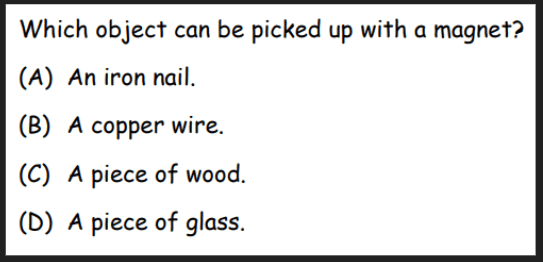
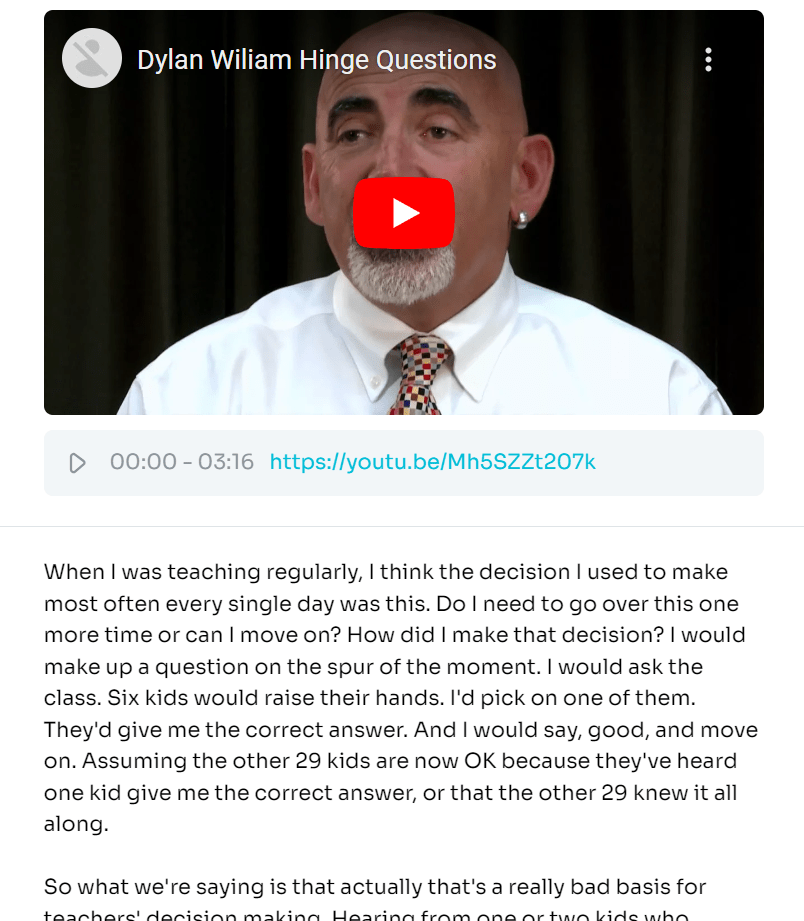
Formative assessments are regular, informal assessments that are used by teachers to assess student understanding and inform teaching strategy. As adaptive teaching requires continual assessment and changes to how we deliver content based on this assessment, it needs to be frequent and meaningful. One example of how teachers can do this is Dylan Wiliam’s Hinge Questions. He explains these by reflecting on how many teachers will frequently make decisions about the success of their instruction based on the response of a few students, for example, asking one A4L question, get one response and assume from this that all other students had the same answer. This approach is insufficient for gauging overall class understanding. Instead, we need to use “hinge questions” every 20 to 30 minutes, these are questions designed to quickly assess the entire class’s comprehension. These questions are concise, allowing for swift responses and immediate decision-making by the teacher. The key criterion for such questions is that students must provide correct answers for the right reasons, ensuring meaningful assessment. By incorporating various response methods like ABCD questions, whiteboards or electronic clickers, teachers can efficiently gather data on student understanding, making teaching more responsive and engaging while providing valuable insights for instructional adjustments.
According to Rosenshine’s principles of instruction, imaginative teachers have found ways to involve all students in answering questions. Examples include having all students:
Tell the answer to a neighbour.
Summarise the main idea in one or two sentences, writing the summary on a piece of paper and sharing this with a neighbour, or repeating the procedures to a neighbour.
Write the answer on a card and then hold it up.
Raise their hands if they know the answer (thereby allowing the teacher to check the entire class).
Raise their hands if they agree with the answer that someone else has given.
ABCD Questions
In addition to asking questions, the more effective teachers facilitated their students’ rehearsal by providing explanations, giving more examples, and supervising students as they practised the new material.
The following is a series of stems for questions that teachers might ask when teaching literature, social science content, or science content to their students.
How are __________ and __________ alike?
What is the main idea of __________?
What are the strengths and weaknesses of __________?
In what way is __________ related to __________?
Compare __________ and __________ with regard to __________.
What do you think causes __________?
How does __________ tie in with what we have learned before?
Which one is the best __________, and why?
What are some possible solutions for the problem of __________?
Do you agree or disagree with this statement: __________?
What do you still not understand about __________?
2. Scaffolding
Scaffolding aims to provide students with temporary supports that are gradually removed or ‘faded out’ as they become increasingly independent. It is a common component of guided practice within instruction. Teachers are used to the idea of first, now, next – building the bigger picture and making connections for learning. Scaffolding is not just for those who need more support, it is a way to build up complex ideas so that all students can achieve and be stretched. This is why the idea of scaffolding up really landed with me. Examples of this might be:
Graphic organisers
Prompts such as “who,” “why,” and “how” to help students to ask questions while they read.
Checklist to evaluate their work: “Have I found the most important information that tells me more about the main idea?” and “Does every sentence start with a capital letter?” The teacher then modelles the use of the checklist.
Expert models with which they could compare their work.
Think alouds:
I predict ……. will happen next
What do I know about this topic?
This part of the text made me think of….
I think the most important part was…..
I was confused by……..
The main idea of the text so far is……
What new information did I just learn?
I wonder why…
I reread that part because….
I just thought of……
3. Planning Tools
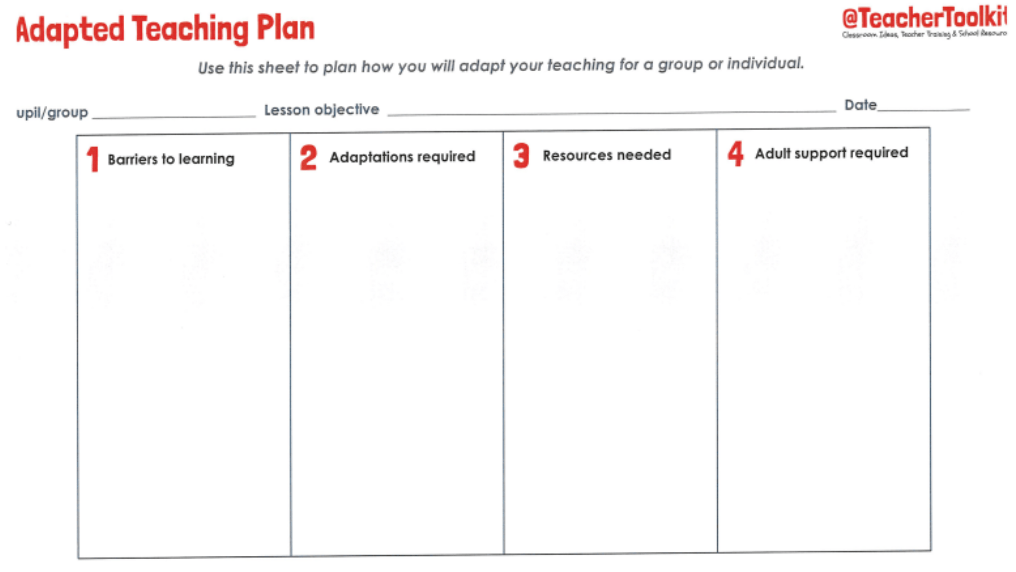
I like this as a tool for planning lessons as it makes you think about ‘barriers to learning’ before the lesson. The reality is, as ‘experts’ we might not be able to fully anticipate these, but taking the time to think about this or reflect on previous years’ experiences and barriers is really powerful. I’m also a realist and know that we don’t always have the time for this…! But as our experience grows, so will our intuitive awareness of what the ‘barriers to learning’ will be. Furthermore, you could add ‘hinge’ questions to this to ensure that you are considering not only the difficult concepts, but also how and when you will check that students are ready to move on.
4. Quick wins with EdTech:
Copilot and ChatGPT
Copilot and ChatGPT are able to change instruction to be more simplified or more complex, you can easily create lesson plans, quizzes, rubrics, model answers, checklists and other resources to suit the variety of learners in your class. As with any generative AI, it’s important that you are very specific about what you ask it to produce and ensure that you check what is produced.
Mentimeter
This is a fantastic tool which can allow you to create interactive ‘hinge questions’, these can be built into a presentation so you can add it to your slides around the 20-30min mark, depending on what tool you choose, it can create multiple ways for you to view the whole class’s responses. These include; word clouds, live and instant polling, entertaining quizzes, informative Q&As etc.
Canva
Canva is an online graphic design tool, therefore it can be used to create graphic organisers for scaffolding. It also has generative AI features called ‘Magic Write’, which allows you to adapt resources appropriately, such as; create short and long text (including paragraph generators, paraphrase tools and summary generators), create outlines of articles etc and provide support in structuring content, and create ‘pros and cons’ lists.
Twee
This is an AI tool which is technically designed for English teachers, however it actually can do a variety of things which would allow teachers to adapt their lessons and resources in a range of subjects. One of my favourites is that it allows you to create a transcript from any YouTube video, which quickly gives you two mediums for students.
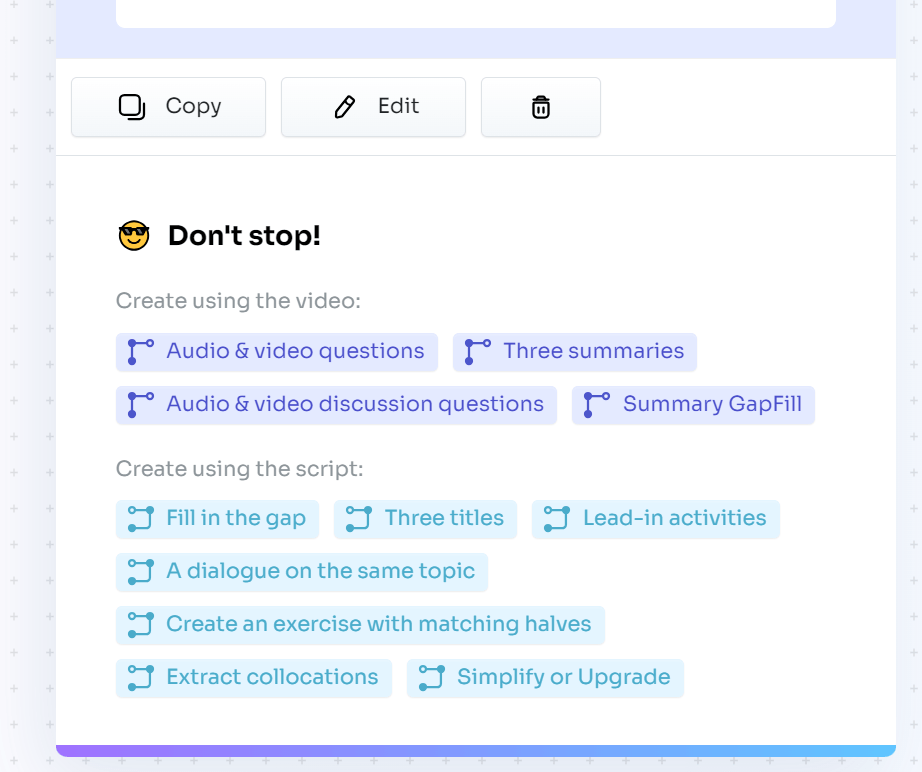
It also can generate questions for any YouTube video in just a few seconds, generate dialogues, stories, letters or articles on any topic and for any level, quickly create multiple choice questions, open questions, and True/False statements. This ‘Don’t stop’ section is fantastic, it generates multiple ideas from the video. This allows you to decide which ones will suit your classes, but is a real time saver.
ThingLink
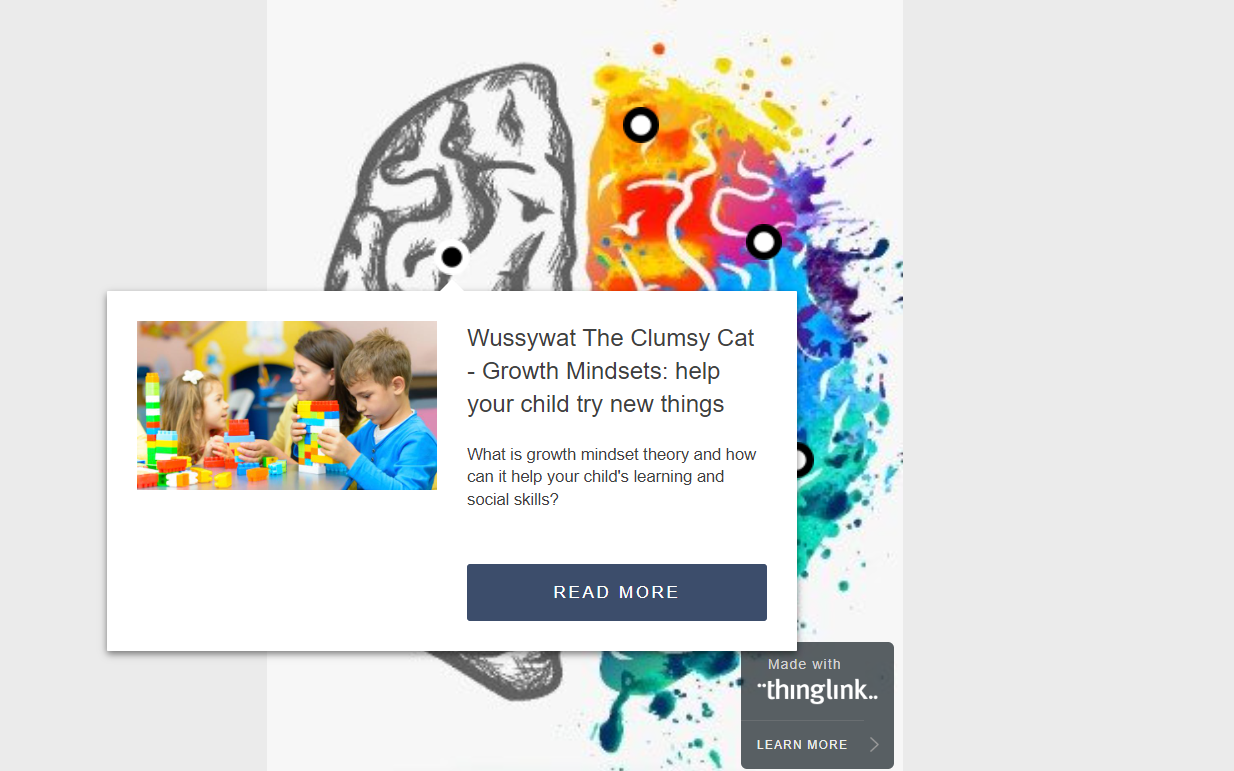
This allows you to create a ‘digital space’ that lets teachers pull lots of different media types into one easy-to-access place. This is great to support and challenge students depending on what you include. I actually like embedding the interactive ideas from Twee into a ThingLink, they are a great collaboration of resources to support adaptive teaching.
Each of these dots on the image represent a different media. Therefore this image has various different forms of support, scaffolding, activities and challenges, linked to the topic.
These tools all have a free or freemium element, which is enough to support teachers in creating adaptive resources for students. As I alluded to earlier, there are also tools which can be used parallel to lessons to support students which have adaptive elements to them. The main ones which are worth ‘investigating’ are Google Practice Sets and Microsoft Learning Accelerators. But the main aim of this session was to support teachers in ideas and tools to support the resources and strategies that they use in the classroom.
Conclusions
It is refreshing to see that ‘differentiation’ has been ditched for an approach which should allow all students to achieve their potential. Adaptive teaching means that we have the same high expectations and ambitions for all our students and our planning is about how we can support them in getting there. That’s why we need to consider whether adaptive teaching strategies are within the toolkit of every teacher in your school and what sort of further CPD we can provide to help them in having these. Equally, are we ensuring that there is a pygmalion view of all students, is the language used in schools emphasising that all can achieve with the right approaches or is there still a tendency to ‘pigeon hole’ students. Finally, how appropriate are the types of assessments we are doing before, during and after lessons to ensure that teaching is adapted to achieve this aim, the aim that all students can achieve? Ultimately, unlocking the potential of all our students is our aim as teachers.






 This Teacher Blogs