
… in the AI classroom.
For the first Teach Meet of the new academic year we held a collaborative session sharing an Action Research project that we carried out in Northwood College for Girls GDST in the Summer term of 2023 and was led by Debbie Hill, Trust Consultant Teacher for Educational Research. As part of the research project, myself, Reece Merk Assistant Head (Academic) at South Hampstead High School and previously Head of Science at NWC, Adam Giblin, GARC Fellow, Associate Assistant Head and Head of RPE at NWC, Stefanie Chadburn, Associate Assistant Head and Director of Sport at NWC, and Vicky Atkinson, Head of Classics at NWC joined together as we all have a shared passion for research within Teaching and Learning. For the Teach Meet itself, we wanted to not only share what we did and why, but also to consider why conducting Action Research will matter even more as we are moving to an evolving AI classroom. Now, I must confess, I’m actually on maternity leave at the moment, so I don’t feel as in the loop on AI in the classroom as I could, however, copious amounts of TV over the last 17 weeks has shown me adverts on Meta Quest 3 headsets (from Argos – other retailers are available) which is using VR and AI as a teaching tool and marketing adverts using buzz words such as AI and Machine Learning, so the reality is, our students will be going into an AI workforce which means we do need to prepare them by rethinking how AI can be embraced or even re-shape our classrooms. Given how education is currently progressing, and how AI is becoming part of this educational experience, action research which assesses how best students learn such as ours on flipped learning, will matter more than ever too.
Before the AI revolution, we had wanted to conduct action research and Debbie came to Northwood to facilitate a group discussion on what we were interested in/had concerns about in our various roles. Interestingly, although our subject areas are very broad we easily identified confidence and independence as areas we wanted to unpick. Then, with some of the buzz around AI (and ChatGPT more specifically) starting to hit the media, we decided on looking at the strategy of flipped learning, whereby students ‘acquire’ knowledge before the lesson, in more depth. Given how Large Language Models (LLM), such as ChatGPT, then transformed teaching in the months that followed this initial discussion, we couldn’t help but consider how flipped learning and AI are connected. Students can generate their exam answers using ChatGPT, and they can be very convincing, therefore, homework which is exam practice could become pretty redundant. As teachers, it will be hard to mitigate who is/isn’t using it, how much they are using it etc. which alone will cause disparity. And although not all will do this, enough will, to make exam practice as homework not that meaningful. Therefore, exam practice, something which is crucial for gauging students’ understanding and attainment, needs to happen in class. Otherwise, how will we accurately assess their understanding of that specific question topic or skill? So then we need to consider, how do we make time in the lesson to allow for timed practice? This is where flipped learning comes in. Can we make our classrooms more pacy and efficient through flipped learning, which we can then assess in class, via timed practice?
Equally, can we use some of the digital tools that are becoming so widely available to help us create flipped learning resources?
Why Action Research:
Debbie Hill, our TCT for Educational Research and brilliant advocate for Action Research delved into how we as classroom practitioners and lifelong learners, engage in reflective practice daily. And we do this to improve the quality of our teaching, develop our knowledge and skills, and in so doing, improve the learning experience, and outcomes, for our students. Action Research enables us to trial something new in our classroom and through a process of robust data collection and analysis we can answer our own questions: does this strategy work? Has it had an impact? How do we know? Furthermore, the GDST is a research-engaged family of schools; staff are encouraged to become ‘consumers’ of research, to read widely, with multiple opportunities to come together and discuss how we might take some of these ideas and use them in our own context. With Action Research, we become producers of research, albeit on a small scale and in our own context, however, we are in the driving seat of our own professional learning to create a robust and relevant piece of classroom-based research on a theme of direct relevance to our practice and our students. We constantly reflect on our practice and trial things; Action Research is just a more systematic way of doing exactly what we do on a daily basis. Some may argue that Action Research can be expensive and time-consuming or have little impact. There is a time investment, of course. If you can work with colleagues as part of a collaborative endeavour, as we did at Northwood, not only does this share the workload but also the great ideas which surface (tacit teacher knowledge) when teachers come together. Finally, what really matters, is sharing these research findings, whether that is within one’s own school setting or more widely, which is what we are going to do. Debbie explained how she has never met anyone who regretted undertaking an Action Research project; it can get messy, overwhelming at times, and the data might not show what you had anticipated. But the whole process is such a rich form of professional learning, deepening reflective practice and having a positive effect on classroom practice and outcomes.
Adam Giblin, GARC Fellow and Associate Assistant Head at Northwood is incredibly knowledgeable about the importance of Action Research. In his project “But What can I do About it?” Using Design Thinking in the Classroom to Increase Advocacy in Year 11 Girls, he was able to set clear goals, gather data more effectively and replace trial and error with sustained, reflective, well informed Action Research. In our Teach Meet, he asked the questions:
- Who has ever seen something another teacher has done or read about a new practice and thought “I wonder how that would work for me?”
- Who has ever tried something new? Tried something that didn’t work? Did you reflect on why?
- Who has ever taken some student voice about what they’ve done in a lesson?
If this is you, then you have already started your Action Research journey, and the reality is, there won’t be a teacher who hasn’t considered at least one of these questions, if not all. That is because Action Research is an opportunity to learn about your own teaching and how you can be impactful for students.
So why do we need to think about creating more opportunities to conduct Action Research in an AI world? Adam shared some particularly important statistics about the world of work that it is predicted our students will be going into. Research from the World Econ Forum states that more than 75% of companies are looking to adopt technologies including, cloud computing, big data, and AI in the next five years. In the same research they predict that 42% of business tasks will be automated by 2027. This includes 65% of information and data processing tasks. The future economy demands a move away from a curriculum based on knowledge retention. In a recent conference at Epsom College, they were talking about ‘PedTech’ (post pandemic pedagogy). Thus, carrying out Action Research is important for us today, we need to harness the power of our classrooms to understand that the student of today is very different to the student we had as recently as 5 years ago. We need to ask the question; what are we educating for?
Why flipped learning:
So what was the Action Research question we ultimately decided to investigate? ‘How can a flipped learning approach build knowledge acquisition in order to enhance confidence in Year 10 students when applying their understanding in class?’
Stefanie Chadburn, Associate Assistant Head at Northwood, explained the research behind flipped learning and strategies to improve confidence. Research has shown that oracy is essential for boosting students’ academic confidence across subjects, where students are given the space to explore their ideas in order to deepen cognitive understanding of topics through application (Simon, 2022). With this in mind, the use of flipped learning was highlighted as a potential tool which could facilitate this exploration and allow for greater emphasis on application, rather than acquisition.
Flipped learning is a concept which has been utilised in different forms since the late 1990’s, but has been used more widely since the early 2000’s (AdvanceHE, 2020). Bergmann and Sams (2012) used the phrase flipped classroom to present a teaching strategy which considered the use of time spent by teachers with their students within the classroom. The Flipped Learning Network (2014) published a definition of flipped learning, which aimed to minimise the misconceptions that surrounded the term. It was presented as ‘an approach in which direct instruction moves from the group learning space to the individual learning space’ in order for the group space to be ‘transformed into a dynamic, interactive learning environment where the educator guides students as they apply concepts and engage creatively in the subject matter’ (Flipped Learning Network, 2014). When applied to teaching and learning, it is about changing how you use the individual space (for example, homework), compared to the group space (for example, classwork), recognising where you can be of most benefit to all students (Slatford, 2019). Therefore, it could be argued that flipped learning is a strategy that reverses the traditional classroom model of teaching. Students first learn the material through online videos, reading assignments, or other digital content before coming to a lesson. The time in lessons is then used for discussion, hands-on activities, and collaborative projects that build on the learning acquired before the lesson. The aim is to create a more student-centred approach to learning, where students take more responsibility for their own learning and are given more opportunities for active participation and engagement.
So how are AI and flipped learning connected? AI will play a vital role in deciding how we design learning and pedagogical approaches. AI tools could make some approaches redundant, such as exam practice as homework, equally, we as teachers can use AI to better develop teaching strategies and resources. Using a flipped classroom approach will enable students to collate and read the contents with AI-supported learning tools prior to the face-to-face class lessons, whereas, in class, they should be expected to critique the collated information to make it meaningful to specific teacher led questions, exam practice or through critical tasks which expect them to critique/evaluate the collated information, thus improving their depth, rigour, and critical awareness of the topics they have looked at prior to the lesson. Therefore ensuring that students are confident in utilising flipped learning approaches to allow them to effectively engage in application and evaluation tasks within lessons is key.
What we did:
Vicky Atickinson, Head of Classics put together information on what we did and why. We decided to carry out research on Year 10 as the teachers involved in the project all had classes in this year group and there was some overlap in students. Biology had one group of 18 students, Classical Civilisation one group of 13 students and RPE two groups totalling 25 students. All groups were mixed ability classes. The timing of the project in the second half of the summer term worked well as the students had finished their end of year examinations and were starting new topics in all subjects, giving an opportunity to trial flipped learning alongside more traditional ‘control’ lessons.
Over three weeks students had a combination of ‘flipped’ lessons and ‘control’ lessons. During this time peer observations were conducted, giving the opportunity both to observe the implementation of activities in a ‘flipped’ classroom and to speak to individual students in more depth about their confidence in their learning. As part of the flipped learning, students completed tasks on new topic areas as homework prior to the lesson which involved either watching videos (using Edpuzzle) or reading specific text and answering questions or making notes. Various tasks were then set across the three subjects in the ensuing lessons. These could be to assess their learning in the form of low stake quizzes or blurt of knowledge or to look at more extensive exam practice questions either collaboratively or individually. For example in Classical Civilisation students were set flipped work on weapons and armour in Bronze Age Greece. In the next lesson they were put into groups and each group given a different visual source which they applied their knowledge to. We were then able to put all those sources together to collate evidence for the Bronze Age Greeks being a warlike society. In RPE, students were asked to watch two videos in EdPuzzle on prayer, for some students the specific vocabulary was completely new to them and all students were observed using technical language as soon as they came into that first lesson. This also allowed for discussions to move very quickly up to evaluation questions rather than an extended period spent on lower order questioning to ensure they knew and recognised new vocabulary and concepts. In Biology, students were asked to complete an EdPuzzle on the structure of the eye before the first lesson on this topic, which allowed them to pick up and process key terminology such as iris, pupil, sclera and cornea. When students entered the first lesson on the topic, they were asked to blurt as much information onto an unlabelled diagram of the eye as possible. These were then assessed live by the teacher at the start of the lesson visually to help adapt the lesson content moving forward, but then also marked numerically for every correct piece of information to encourage detailed acquisition of knowledge moving forward.
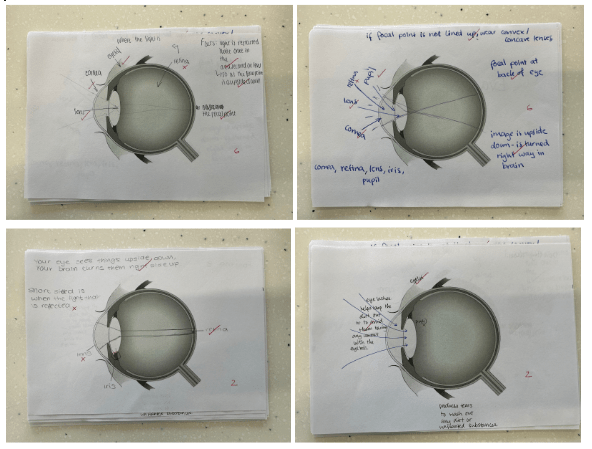
Images of blurting results from the Biology example of a flipped learning class where a video had been watched beforehand. This meant the teacher was able to clearly see which points had been learned correctly (i.e. the idea that light rays cross over when entering the eye and the image is inverted) and those which had not (i.e. the labelling of eye structures) so that lesson time could be better directed towards addressing these errors/misconceptions.
In terms of data collection, since the question focused on the acquisition of knowledge to build confidence, qualitative data was generated from online surveys, observations and focus group interviews. Prior to the start of the project all students were asked to complete a survey on their confidence in eight areas across all three subjects. This gave a baseline against which the development of their learning could be measured. Throughout the process, we also observed one another which was really useful in giving us the opportunity to see how students were applying their knowledge they had gleaned to activities in the lesson and also to engage students in more informal discussions about their perception of their confidence in the acquisition of knowledge which were recorded. At the end of the project, students were given the survey with the same eight areas but now in the individual subjects and specific topics, and for overall feedback on the process.
What we found out:
Reece Merk, Assistant Head (academic) at South Hampstead and previous Head of Science at Northwood went through the results. From our research, students seem to be developing this idea of annotating notes given and resources rather than making unique notes, which was positive and a way to support them in how they move forward into the Sixth Form and University. Flipped Learning seems to be supporting students with lower MidYIS scores and those who receive SEN support. Students were overheard in lessons being more secure in their knowledge and discussing their confidence levels in the work done more often. In differentiated activities, more students felt confident to attempt harder questions or those that indicated greater challenge. Greater engagement in lesson activities from most students, particular improvement seen in those who were usually quieter. Interestingly, although not unsurprisingly, students preferred using videos for learning, and struggled to engage as much with reading resources. Importantly, given the increase in AI use outside of the classroom, the flipped learning approach freed up lesson time to explore higher order questions as there was less time spent teaching the facts, allowing students to apply their knowledge in greater depth and with greater confidence.
However, students STILL show preference for direct teacher instruction as the medium most effective in learning.
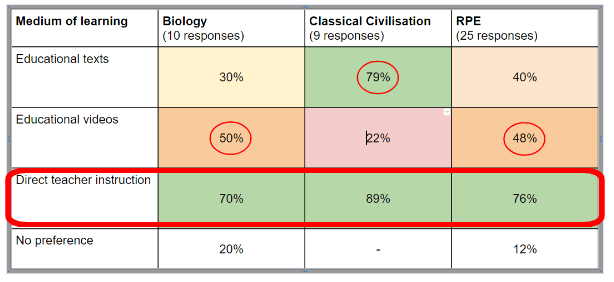

As we can see, the majority of students’ opinions of flipped learning improved, however 20-40% had a negative view across the 3 subjects. This is something that could be looked at as part of further research, from the student voice conducted, it could be inferred that this is down to the view on what ‘the role of the teacher is’ as students still feel a teacher should be giving direct instruction, equally it could be down to the fact that some students found the information given as homework too difficult or that it then made the following lesson ‘boring’ or ‘repetitive’.

Although the percentages of students who found it had a negative impact is low, there are still students who feel this way, which needs to be looked into. Equally, the percentage of those who didn’t feel it changed their confidence in exam questions is very high in Biology and over half in RPE. Given the goal was to improve confidence, this is a slight concern. Again, student voice could suggest that this is down to students’ perceptions of what learning is, if they still hold it as direct instruction, then they may not feel that confident if they find the flipped learning work challenging. Equally, student perception and staff observations don’t correlate here. Staff observations showed that students seemed much more confident. Perhaps if the study itself was longer, we would see more opportunities for exam practice and more opportunities for students to feel that they are making progress and improvements in their exam practice, which in turn, will improve their confidence.


Equally, when students were asked about their confidence in different areas of studying before and after the project, you can see that in most areas, their confidence has improved. So although when asked about exam practice specifically, they didn’t feel more confident, they did in other important skills. Again, with more time, this confidence could grow and that would have an impact on their confidence in exam practice.
Here is some of the feedback that we had via student voice which has helped us draw our conclusions:
In Biology:
“I have found it quite effective as learning the material at home made me more confident in the lesson as I already had a background knowledge on the topic”.
“I’ve found it effective in providing previous understanding so we can ask questions in class however some concepts and topics were slightly difficult to understand on my own instead of learning it in class with the help of the teacher.”
“All of them (media of study) combined in a good balance is effective and helpful because they can provide different information for example: if some information was missed in the video, then that might be covered by the educational text or the teacher.”
Religion, Philosophy and Ethics:
“I found that videos helped me to gain a deeper knowledge of the information compared to the text. I also could tell that the type of videos had an impact on how much I remembered. In the first video of the boy touring us around the mosque, I seemed to remember a lot more than the videos with lots of words…”
“I felt that it helped me get a clear understanding of what we were learning and I could then apply that knowledge to what we were doing in class.”
“For some of the lessons, I felt I learned most of the information in the actual flip learning homework, therefore when relearning it in class, some was a bit boring as I felt I was just revisiting the same knowledge as what we were supposed to learn in the homework.”
Classic Civilisation:
“I feel that before when I was doing exam style questions I used to struggle a bit however now I feel much more confident tackling them because I knew the information.”
“By doing questions in lesson I was able to see how much I actually knew and wasn’t able to look it up on the textbook or online. I was able to see gaps in my learning and go home and fix them.”
“I can teach myself material without a teacher having to explain it all to me.”
“Depending on the topic, I feel it may be easier to understand when the teacher explains it.”
As you can see, there is a lot of positive feedback on flipped learning in our context, but it is still important to discuss the limitations. Firstly, it was only a 3 week study. Now this isn’t a huge limitation, as one of the beauties of Action Research is that it doesn’t need to be hugely lengthy. But it is worth noting as for research carried out by the Education Endowment Foundation (EEF), projects are usually 3-6 months long. Therefore a longer study with more interventions would be ideal to truly demonstrate impact. As the project was completed at the end of the year, learning was more disrupted, this also meant that there was no clear assessment point to see whether students’ attainment have improved as a result. Again, it’s worth noting that confidence was a key part of our question, and to measure this, staff observations and student feedback as data were crucial. However, for a further study, specific assessments linked to exam questions would give further weight to the impact of a flipped learning approach. Finally, although flipped learning did allow more time for exam practice in class, this wasn’t always the case and some lessons still spent lots of time reviewing knowledge from Flipped learning and reviewing gaps. Of course this was useful, but still did not leave enough time for as much explicit exam practice as intended.
Conclusions: Why flipped learning and action research will continue to be important
As we have seen, flipped learning had a positive impact on our students’ confidence, learning attitudes (and attainment). For me, one of the most worthwhile take-aways was seeing how some of our ‘less academic’ or ‘less confident’ students really ‘got it’ in the lessons or came to the lessons with vocabulary that they would have really struggled with had the lesson been their first exposure. Furthermore, in a world where students can use ChatGPT to complete their exam practice, we as their teachers need to reconsider what is best practice for them (and it’s not going to necessarily be exam practice at home). With a steady stream of reports about LLMs passing all kinds of assessments, from open-ended writing tasks to tough post-graduate exams. It can apparently also pass legal exams and medical exams, we can understand why students are tempted to use them. So flipping the learning could be part of the answer to this potential problem.
Within our research, we did come across some areas of concern with flipped learning that need to be addressed:
- Student/staff perception of what learning is (and the role of the teacher) – comments like ‘but you are going to teach us this right?’ This comes from a still widely held view that the teacher is simply someone who stands at the front and lectures. But this isn’t true, teaching is creating and crafting appropriate resources which meet the needs of every individual. This is a huge task, but one that can be made easier with AI and flipped learning.
- Mistakes and misconceptions – we know that if students learn something that is wrong and it’s not addressed promptly, they can remember the wrong information and not the correct information. This is a danger of ChatGPT and its hallucinations as these are generated answers which are completely wrong, but generated to sound convincing. Equally, if a student misunderstands a piece of flipped learning and then misses the lesson where you go over it, they will have gone even longer with the wrong information in their minds.
- Not engaging with the homework – not something we particularly have to worry about in our setting but it is a concern. Equally, if we don’t address the ‘perception’ of what a teacher’s role is, even our diligent students who just happen to believe that flipped learning isn’t learning, will not engage with it fully either.
That being said, the benefits clearly outweigh these issues. Especially when we make flipped learning the ‘norm’, students will engage, mistakes and misconceptions can be addressed in the safety of the classroom (or in the safety of the student/teacher dialogue) and it goes without saying that learning is not simply being told facts by a teacher…
This is why reducing exam practice as homework and building it into lessons will better equip students. It also allows a more genuine reflection of their learning. Through flipped learning, this becomes more possible as this allows for lesson time to be freed up to build in the practice. Furthermore, there are lots of digital/AI tools which can support teachers in setting flipped learning:
- You can use ChatGPT to simplify content from textbooks/articles – just proofread it!
- Again, you can use ChatGPT to generate comprehension questions to ensure students are engaging with reading.
- EdPuzzle and GCSE Pod are great for creating video based assignments
- You can even create interactive worlds for them to explore using ThingLink. And although it takes time to set up, once it’s done, you can set it over again and tweak the digital content as specifications change rather than starting again.
I just want to say a huge thank you to Debbie, Recee, Adam, Stef and Vicky. Their passion for action research, reflective nature and enthusiasm for sharing best practice makes them an absolute pleasure to work with. I hope you have found this insightful, with some practical takeaways too, and hopefully you are now thinking about conducting your own piece of Action Research. The teaching profession is never dull, and although some might have you concerned about AIs place in the classroom, it’s actually a great opportunity to embrace it and ensure that the technologies that you do use are right for your students and your context.
 This Teacher Blogs