

As the digital landscape continues to shift beneath our feet, one thing is increasingly clear: artificial intelligence isn’t a fad, it’s a future-defining force. For educators, the challenge is no longer whether to engage with AI, but how. And for our students, it’s not just about learning with AI, it’s about learning how to think alongside it.
The world of work our pupils will inherit is rapidly changing. McKinsey & Company (2023) forecast that automation and AI could displace up to 30% of current work activities by 2030. But rather than AI replacing humans outright, we’re seeing the emergence of the “Centaur” and “Cyborg” models of productivity. In a Centaur model, humans and AI work together; the human leads, the AI supports. In the Cyborg model, the lines blur; AI tools are embedded in how we operate (Shneiderman, B., 2022). While both have merit, it’s the Centaur that offers students the greatest opportunity to thrive, be thoughtful, creative, and in control.
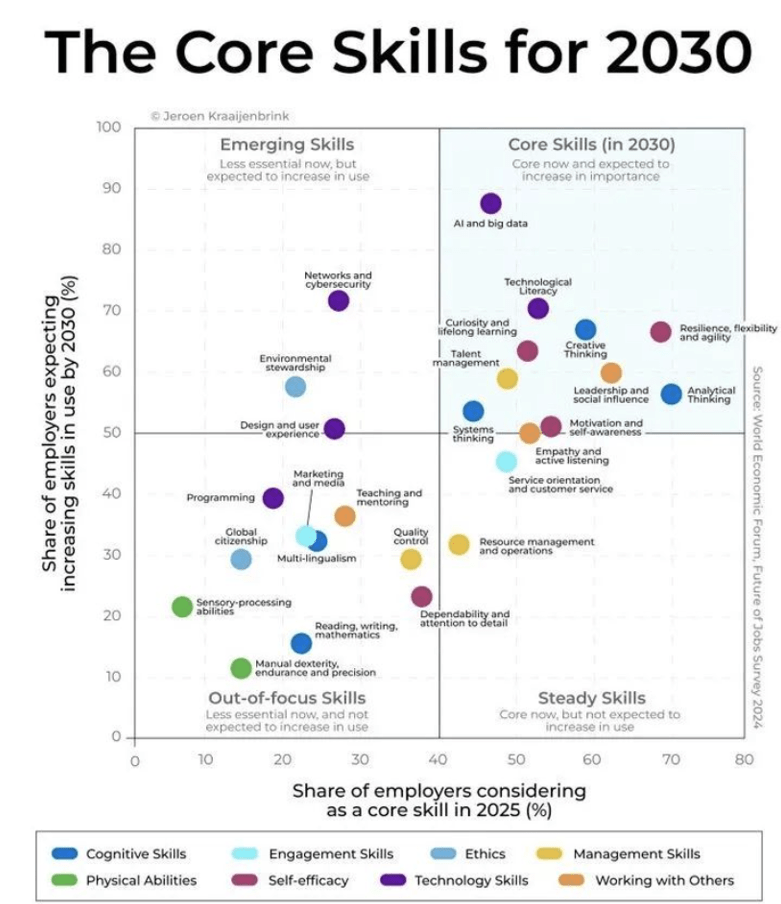
This distinction matters. As educators, our job is to prepare students not just to use AI tools, but to collaborate with them ethically and intelligently. That’s why our latest CPD offering focused on helping staff meaningfully integrate AI into lessons; not as a gimmick, but as a way to enhance understanding, boost creativity, and promote critical engagement. Not to mention, ensuring that our students have the core skills required for the future, as highlighted by the Worlds Economic Forum, Future of Jobs Survey 2024.
This is why at Berkhamsted, we have designed age-appropriate AI tasks for students engage with that are grounded in evidence-informed principles to support high-impact learning. Core principles such as retrieval practice, metacognition, critical thinking, student voice and self-efficacy were all incorporated into tasks and AI prompts. These were then shared with staff and trialled in various subjects from Year 7 to Year 13. The reach and flexibility of AI enables students to take the lead in shaping their learning, becoming Centaurs as they utilise AI for support.
As Shneiderman (2022) argues in Human-Centred AI, it’s the Centaur approach that best supports ethical, responsible, and cognitively rich engagement with technology, particularly in education. And Kasparov (2017) reminds us that in chess, the best outcomes didn’t come from AI or humans alone, but from Centaur pairings of both. The activities we designed weren’t created for AI, they were created for students. AI just makes them more dynamic.
Teaching students to be Centaurs, not passive recipients of machine output, but thoughtful collaborators, is our moral imperative. This doesn’t begin with grand declarations, but with lesson plans, with prompts, with playful experimentation.
So, start small. Start with curiosity. Start with evidence-informed pedagogy. And most of all, start with students.
References
- Abrami, P. C., Bernard, R. M., Borokhovski, E., Waddington, D. I., Wade, C. A., & Persson, T. (2015). Strategies for Teaching Students to Think Critically: A Meta-Analysis. Review of Educational Research, 85(2), 275–314.
- Agarwal, P. K., & Bain, P. M. (2021). Powerful Teaching: Unleash the Science of Learning. Jossey-Bass.
- Bandura, A. (1997). Self-Efficacy: The Exercise of Control. Freeman.
- Education Endowment Foundation. (2018). Metacognition and Self-Regulated Learning.
- Kasparov, G. (2017). Deep Thinking: Where Machine Intelligence Ends and Human Creativity Begins. John Murray.
- McKinsey & Company. (2023). The State of AI in 2023: Generative AI’s breakout year.
- Mitra, D. L. (2004). The Significance of Students: Can Increasing “Student Voice” in Schools Lead to Gains in Youth Development? Teachers College Record, 106(4), 651–688.
- Shneiderman, B. (2022). Human-Centered AI. Oxford University Press.
 This Teacher Blogs