
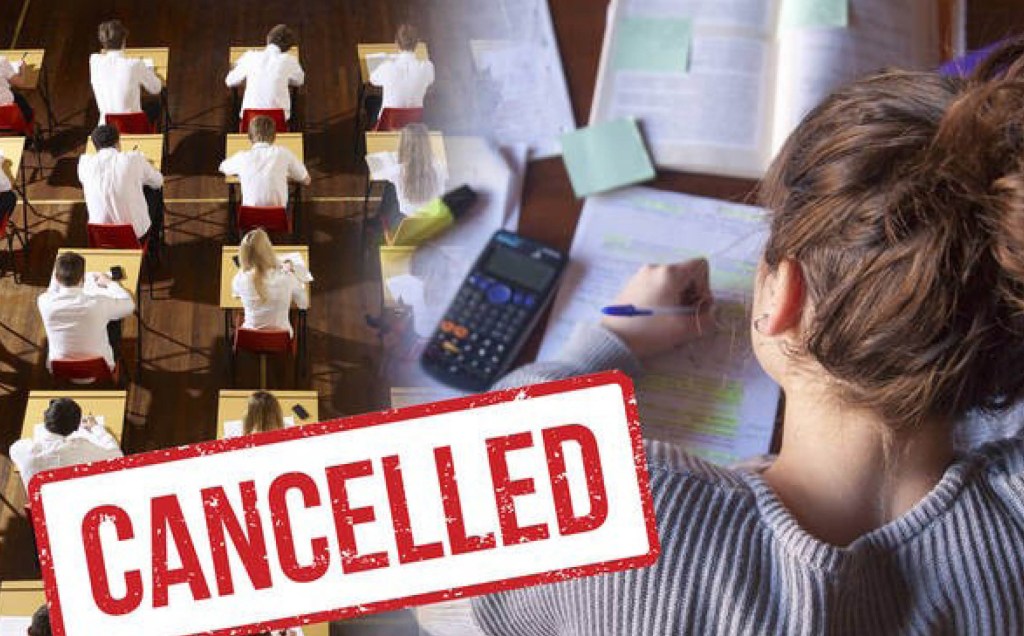
For our most recent Teach Meet, we discussed ‘exams, what are they good for?’. This was inspired by a debate I listened to from UCL on ‘What if… we got rid of GCSEs?’: It’s for this reason that the discussion focused more on GCSE’s as these are exams that all students will take, whereas 11+ and A Levels are not required for all. This also felt like an important topic as over the past two exams seasons we have seen CAGs and TAGs, and all with their complexities. However, I think it’s fair to say that a lot of us in the teaching profession have recognised that the process of TAGs in some ways seemed more fair and has only further highlighted the pitfalls of end of year terminal, high stakes exams. Yet, in schools there isn’t much call for getting rid of terminal exams, due to concerns around accessibility, equity and well-being. How could we ensure that TAGs are fair, schools are not pressured by parents or league tables and how can we prevent unconscious bias when marking? But once again we have experienced a year of educational disruption due to COVID, and can we hand on heart say that the quality of online learning has been equal across the country? Will a student who has had to isolate multiple times over the past two years have the same educational experience as someone who has not? All of this is why we need to really consider, what are exams actually good for? Do they have a place in the future?
Once again, we discussed three provocations; what is the purpose of exams (GCSEs), can we trust GCSE grades and what could be the alternative?
What is the purpose of exams/GCSEs?
In the UCL debate, Tim Oates (Group Director of Assessment Research and Development, Cambridge Assessment), looked at highest performing ‘systems’, not just those who have exams, and of the top five performing systems, all of them had high stakes assessments at 16. Of the 19 countries looked at (with high performing systems), two thirds had external high stakes assessments at 16. Although, not necessarily in as many subjects as we currently have here in the UK. But it can be said that exams at this age seem ‘the norm’.
So then, what is their purpose? We use GCSE specifications to structure schemes of learning, provide resources, provide curriculum coherence, staff development, independent assessment and accountability for schools. Unfortunately, the accountability element has overshadowed other more important purposes, especially as everything said before doesn’t really have anything to do with the students’ needs.
For students, we could argue that exams or GCSEs provide motivation for students and, of course, data on performance. They let us know about a child’s achievement in subjects and allow students to progress (further education). But do GCSEs really do this? When it comes to achievement, does the terminal exam really show what they have a deep understanding of? Significantly, exams are never a test of everything they have studied. And, if their aim is progression, then do the current exams really build the skills that they need to get on in the future?
One point that came from this was that although they don’t feel fully fit for purpose, they do serve one important purpose which is ensuring that students have some record and acknowledgement of their achievements. This is also something that Gill Wyness (Deputy Director, The Centre for Education Policy and Equalising Opportunities, IOE) explained in the debate. Evidence shows that the lowest attainers often don’t go on to complete anything above the GCSE, therefore if we abolish them, these students will have no marker of their attainment. Therefore it does serve as an important standardised benchmark.
Can we trust GCSE grades?
Next we looked at ‘trust’ and whether we can actually trust the grades that students are given. David Sherwood (Managing Director of Silver Bullet) looked into the way that grades are awarded. For example, a young person gets a grade 5 in History – is that trustworthy? Well, it’s overseen and regulated. Why wouldn’t it be? If we are not sure, we can have a second opinion just like in fields such as medicine and the law. We know examiners can get it wrong, and we were able to get scripts easily re-marked. However, since 2016, such an appeal has been disallowed. You can appeal, but the grounds are very narrow. Therefore, for years, people have been denied a second opinion. Now this seems odd as in 2010, Ofqual had 14 subjects double marked. Once by a ‘regular examiner’ and then again by a ‘senior examiner’. Surely only a few discrepancies? And that these discrepancies would be random. However, this gave two key results: 1. The discrepancies varied significantly by subject; 2. The discrepancies are bigger than you might have thought, e.g. 4 in 100 scripts in Maths had discrepancies, around 25 in 100 in Geography and around 45 in 100 in History. Therefore 1 in 4 grades are wrong, so how can we trust them? This is further skewed by the fact that the new numerical grading system, where the percentage that achieves a grade 9 changes each year, has meant that in one year 50% could get you a grade 4, and in another year this can get you a grade 7.
Gill Wyness looked at whether the fairest form of alternative assessment is teacher assessment and looks specifically at issues around bias. In her research she looked at how students taking the 11+ are assessed internally and externally, and the data that this provided. They found significant differences in their attainment from these two assessments. Black Caribbean children were likely to receive a grade lower from their teacher than from their final external test score, than white pupils. The same was true of students from poorer backgrounds. This research was also carried out on predictive grades and their accuracy, this shows that teacher predictions are often overinflated for certain groups.
We discussed the fact that in many industries, grades are very rarely looked at. They may look at the school or University that you come from but past a certain point, GCSE grades lose meaning when compared to genuine work experience and work based skills. Building on this line of thought, Christopher Napleton (Teacher of English with RSP at Sir John Lyons) introduced some interesting pedagogies from ‘democratic schools’, such as Sudbury Valley in Massachusetts and Summerhill School in Suffolk. A democratic school is one where students are trusted to take responsibility for their own lives and self-directed learning, and for the school community. Students can choose their own activities, they are free to engage (or not) with any course that is offered. These schools will accept students across a wide range of ages (commonly age four through the late teens) and do not segregate students by age, so that students can learn from interacting with other age groups. Most interestingly to our conversations, democratic schools don’t test students, because they hold that each person’s education is unique and personal, and that the very act of testing interferes with self-motivation and self-direction. That being said, when you look more closely at these schools there is still either some form of qualification or an option to sit exams. Once again, there is still evidence that for students to reach the next stage in their career or education, they need something to show where they are. For Sudbury in America, they offer a graduation procedure to students who seek a high school diploma and have been enrolled for at least three years. At Summerhill in the UK, they do still have the ‘option’ to sit exams. They can prepare for and sit GCSEs (the UK national examinations) or concentrate on other passions such as art, woodwork, science, music or just play outside in the rain.The removal of exams all together seems far from likely without a complete overhaul of all educational institutions, and there appears to be very little appetite for that.
What could be the alternative?
Having looked at ‘Democratic Schools’ as one view, we then discussed what other alternatives there could be for the exam system that we currently have. A system that still allows for ‘testing’ but not as we have seen it before. I used the suggestions from Tina Isaaxs (Honorary Associate Professor of Educational Assessment, IOE) in the debate as some alternatives and to see what else we could come up with. Tina Isaaxs had the following suggestions:
- Introducing GCSE ‘Light’ which is a set of tests, not exams, and these can be developed by independent agencies, free from Government interference.
- English, Maths and Science should be tests that are completed by 18 years of age, not by 16, and that these are the only exams to be assessed externally.
- Make EBACC subjects compulsory for all, but these subjects are only internally assessed. Outcome is assessed on 60% examination, 25% coursework and 15% teacher judgement.
Adam Giblin (Head of RPE at Northwood College for Girls) suggested looking at a mixture of shorter, more frequent examinations which are taken unit by unit or periodically over a period of time, perhaps up to the Spring term of Y11, followed by a final summative project-based assessment; similar to a mini-EPQ. How this would work might differ depending on subject but the basic principle of students using the knowledge they gain in Y10 to produce a more independent product/final project would be there. Students could make use of the smaller tests to see which area of each subject they might be best at developing a project in, playing to their strengths and giving them the best chance of achieving a good grade. Asking students to take time and sustained effort to produce something and develop an expert knowledge of a subject area will give them a better preparation for life at work. The short testing would also mimic work where we have to regularly take compliance tests and CPD, which is usual in most careers now.
To think even more radically, he suggested that we could have the short, unit based testing completed in Year 10/start of Year 11. Then in Year 11/12 develop into more “subject specific testing” in Year 11/Year 12, for example, English essay testing, Science experiment testing, History evidence analysis testing, which is still shorter, and then a Year 13 consisting of a project, volunteering (which is credited), higher-courses or extra-credit courses, First-Aid, work experience, etc. This model is more similar to those found in the USA, but would allow for students who are applying to universities to show their quality beyond exams and prepare those going into training or work with skills for their chosen careers. Of all the iterations of this idea, this is particularly interesting.
Conclusions
It is clear that not every student is ready to take exams at 16, so could we not consider the flexibility of allowing students to take qualifications when they are seen as ready? This might be sooner for some, and later for others. Models that look at democratic schools also have their merit, especially when considering future proofing students. But here there could always be a hierarchical issue of schools which take this approach being seen as less academic and then students who go to these schools and do seek out Higher Education could be disadvantaged. Finally, a move to a more modular and project based approach could be exciting, but requires a potential rethink of whether students are able to leave education at 16 if we were to follow a model similar to the USA. This approach requires much more thought: how would this be marked, how would it be supervised, what scaffolding would be required or allowed for students? From our discussions, it is clear we do not feel that the system we currently have in place is completely fair, nor does it actually provide our students with the skills that they will need beyond the classroom. However, it is also clear that alternatives are not particularly fair either, nor do we have the educational gravitas to bring at this present time. Interestingly, when listening to the debate, they did mention that when students were asked if they would rather have teacher assessments or sit the exam, the majority said that they would rather sit the exam. The debate itself ultimately concluded that externally marked exams at 16 is the best option we have. However, this feels like a shame, given the past two years of exam disruption, now feels like the time to push for change.
References
A.S.Neill’s Summerhill School. (n.d.). A.S. Neill Summerhill School. AS Neill Summerhill School. Retrieved April 12, 2022, from https://www.summerhillschool.co.uk/
Chapman, H. (2022, February 7). GCSEs and A levels 2022: ‘Grave’ fears over exam help ‘fairness’. Tes. Retrieved April 12, 2022, from https://www.tes.com/magazine/news/secondary/gcses-a-levels-2022-grave-fears-over-exam-aid-fairness
Sudbury Valley School. (2020). Sudbury Valley School. Sudbury Valley School: Home. Retrieved April 12, 2022, from https://sudburyvalley.org/
What if… we got rid of GCSEs? | IOE – Faculty of Education and Society – UCL – University College London. (2021, April 29). University College London. Retrieved April 12, 2022, from https://www.ucl.ac.uk/ioe/events/2021/apr/what-if-we-got-rid-gcses
 This Teacher Blogs