

Part 1
I think we can all agree that when it comes to COVID and the year that was 2020, there is not much we wish to ‘keep’, in fact, for many of us, there is a lot we will want to forget. However, we cannot deny that it has accelerated teaching and in particular how teaching can use technology as a tool to enhance learning. At Northwood College for Girls, our digital vision set out in 2018, was one of organic growth. We didn’t want digital to be shoehorned in, but rather wanted to allow it to slowly take root and flourish. But in early 2020, with the sudden realisation that a national lockdown was imminent, we put in place many measures to support Guided Home Learning. The success of GHL has meant that the school has been able to continue supporting all of its students throughout lockdown and beyond, although I am now all too aware that we may never again get to enjoy a snow day… Even so, my first and my most important COVID keep is the one published by the EEF, that ‘Teachers are still better than any piece of technology’. Although technology has come into its own, there is no better tool for the classroom than us skilful teachers, and there certainly won’t be any Robot Teachers coming to replace us.
So just as teachers had to upskill overnight, online platforms upped their game too. That is why my second COVID keep is simply the impressive range of quality online resources, this means that even in life after lockdown, teachers can continue to use online platforms to enhance their teaching. Here is just a selection:
- SecEd: https://www.sec-ed.co.uk/best-practice/coronavirus-covid-19-home-education-schooling-resources-schools-teachers-parents/
- SENECA (good for English, Maths, Science, Geography, History – not that good for RPE): tells us where there are holes in knowledge and question styles. Also tells you about the student usage.
- GCSE Pod for all subjects
- Everlearner for PE
- Uplearn for Science
- Educake good for collating data
For Northwood College for Girls, the Google Suite was by far the most effective platform. Classroom in itself has been transformative, but that is not to forget all of the other wonderful Google Tools. In September we dedicated a whole INSET day to Google Training, which saw over 30 members of staff achieve their Google Level 1, a pretty impressive achievement. I would also like to point out that SLT approved this training well in advance of the pandemic, talk about forward thinking…
So, as an established nerd and lover of all things educational research, I wanted to look at how the metacognitive strategies that we already know work so well, can be adapted to work in a hybrid way, specifically; Dual Coding, Spaced Retrieval and Low stakes testing.
Dual Coding
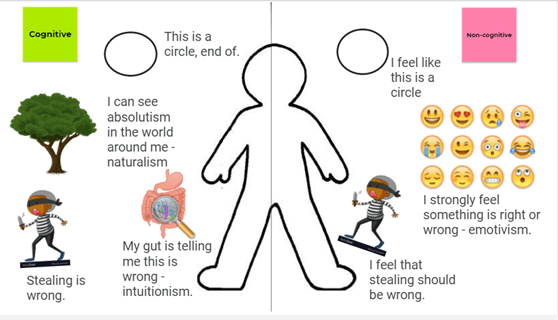
This is the process of combining visual material with written materials to enhance memory. Two applications which are particularly useful for this are Jamboard (G Suite) and Mindmeister.
Jamboard is an interactive whiteboard, it makes learning visible and accessible to all collaborators on the jam session. Through Google Classroom assignments you can upload a template Jamboard and ‘make a copy’ for all students. This can be used for dual coding as you can pre-load images and text onto a Jamboard and ask students to explain the links. Or you can give them images which they need to explain.
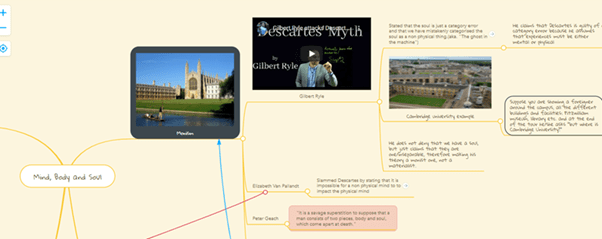
Mindmeister is an online mind mapping application that allows students to visually see their notes, add images and videos too. Our head of RPE has used this really effectively and his A Level students are big fans.
Spaced Retrieval
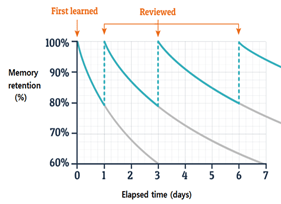
This is the principle that information is more easily learnt when it is split into short time frames and repeated multiple times, with time passing between repetitions. It is the opposite to cramming.
This idea is also supported by one of our Teach Meet articles from last year ‘Forgetting as the friend of learning’ by Robert A. Bjork and Elizabeth L. Bjork which explores certain conditions that produce forgetting also enhance the learning of that information when re-studied.
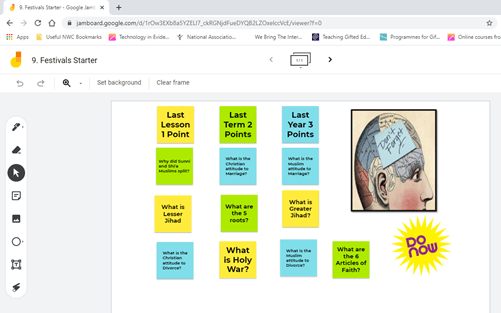
To support this, I have been using a few online versions of resources I had created pre-COVID. But I will be keeping the digital versions as they allow me a much clearer view of the students’ understanding. First is an example of a lesson starter where I would ask students in Year 11 to ‘dump’ down their knowledge from ‘last lesson’, ‘last term’ and ‘last year’.
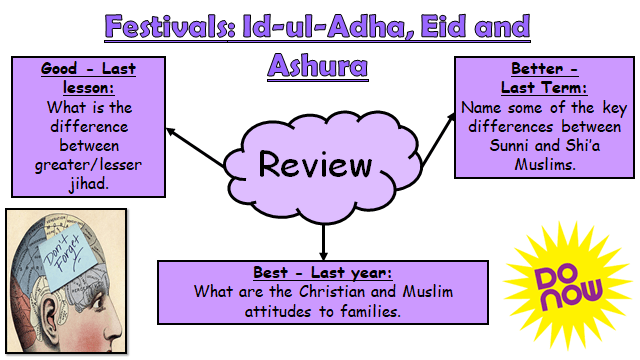
But using Jamboard, and making it an assignment (and selecting ‘make a copy for each student’), I have asked the same questions but rather than relying on some A4L questioning of a few students, I can see via Google Classroom, all of their responses.
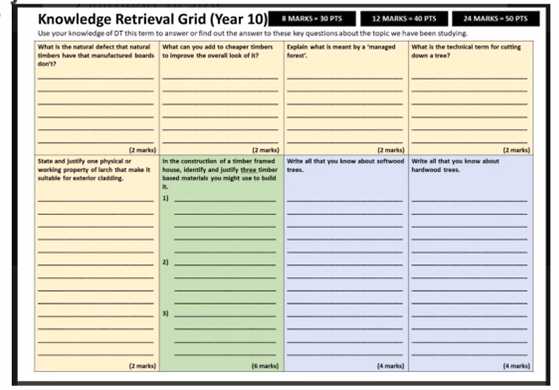
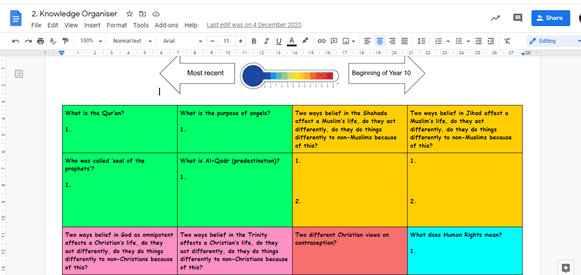
Here is another example, (although the original sheet is from a DragonFly course), I have used this idea to create a similar Google Doc for my year 11s. Again, by being a Google Doc, I can see their answers instantly.
Low stakes testing
This can be in the form of ‘retrieval practice’ which means deliberately recalling previously visited learning to enhance memory. By doing this as quizizz, it ‘lowers’ the stakes as this appears less intimidating than an ‘exam’ or mock’. Another example of a COVID keep for this is using Google Forms for vocab tests. Using the ‘quiz’ function in Google form, you can create a bank of vocab or knowledge quiz that self-mark too. Not only is this a time saver (once all are created) but we also know that for students to be more confident in ‘harder’ evaluation questions, they must be confident in the key words and concepts first.

Another reason why I will be keeping Google Forms over ‘Kahoot’ or ‘Quizizz’ is that you can export a spreadsheet of results and if you re-test your class on the same quiz, you can update the original spreadsheet each time to see their progress, as well as common mistakes.
Conclusions
Although there might be a lot that we want to forget about 2020, it is important to acknowledge that there were still many positives in 2020 too. It has taught us so much, from patience and empathy, to the ability to adapt and innovate. As we enter 2021, the memories of 2020 will not simply disappear, and in fact we are facing another few months of COVID related obstacles. Therefore, I hope this blog provides you with some positive strategies that can help you as we move through the beginning of 2021 and various forms of hybrid learning. There really are some wonderful things to keep from 2020, just look how far we have come.
References
DragonFly Training, Efficient Teaching and Hybrid Learning, 06.10.2020
Click to access Remote_Learning_Rapid_Evidence_Assessment.pdf
 This Teacher Blogs