

Reflections on presentations by Carol Dweck and James Nottingham
With an emphasis in education on ‘soft’ skills, such as resilience, perseverance and various other ‘character’ traits, schools have been ‘chomping at the bit’ to embed character programmes into their school ethos and even into their lessons. But, how do you teach a child to be ‘resilient’? How do you teach a child to have a ‘growth mindset’? The answer is, you can’t and that is why I have always viewed these ‘programmes’ with an air of caution and even cynicism. That, however, doesn’t mean that I don’t believe these qualities are important, in fact quite the opposite. These character traits are more important than ever. But, we as teachers should be creating an environment where we can help our students develop these traits every day. That’s why we can’t decide that ‘today we are going to do resilience’ and ‘next week we are going to do growth mindset’. Rather, we should be facilitating a mindset for growth in every lesson of everyday. So when I had the fortune of seeing Carol Dweck and James Nottingham, I was intrigued to see what they had to say about the implementation of ‘growth mindset’ and I was very relieved to hear that it wasn’t through ‘character programmes’.
Fixed mindset vs Growth mindset
Fixed mindset is the belief that our intelligence is fixed ‘no matter how hard I try, I will only ever be able to do X’ and Growth mindset is the belief that our intelligence can be developed, ‘if I work hard, practice and keep trying, I will able to achieve Y’. One of the ‘growth mindset’ myths that came out of Carol Dweck’s research was the idea that we are one or the other. However, in reality, we are constantly fluctuating in our mindset.
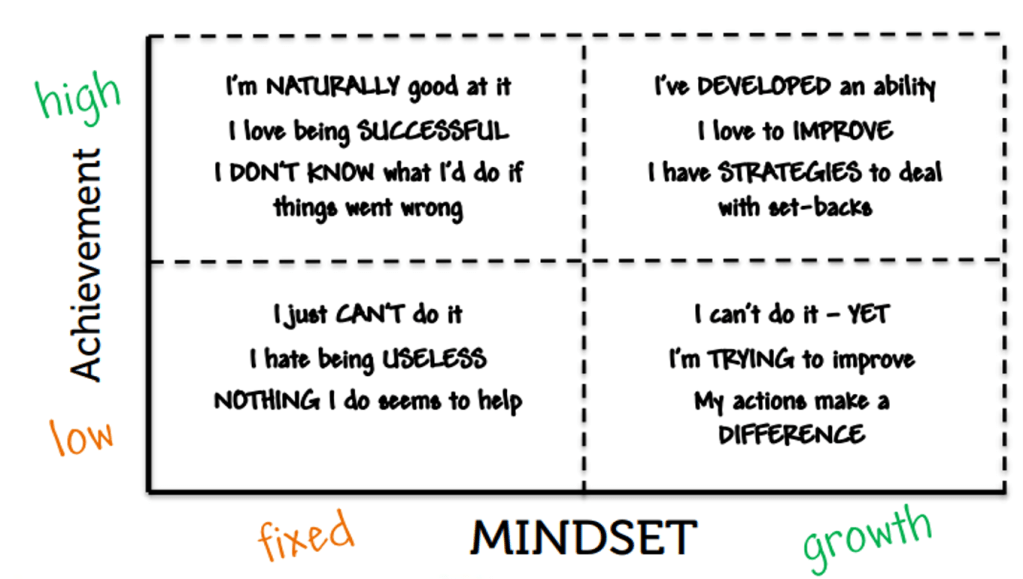
Copyright: James Nottingham
Practical advice from Dweck and Nottingham:
- Don’t make promises e.g. ‘if you practice you’ll get better’ – ask ‘what did you do to improve last time?’ (Answer will often be ‘practice’) – then ask them to look back on the journey, it works better in retrospect.
- The power of ‘yet’ – When a student says ‘I can’t do this’, don’t say ‘yes you can’, which is often the tempting response, instead say ‘I know you can’t, not yet’.
- There is a danger of rewarding achievement e.g. rewarding coming first rather than the process, for example someone who has come from 140th out of 140, to 80th out of 140.
Mindsets take root, only in fertile soil: Applying Growth Mindset, according to James Nottingham.
So the million dollar question for schools and teachers, how do we make Growth Mindset a reality? James Nottingham stated that there are five factors which have the biggest impact on others mindset: Feedback, Success, Mistakes, Personalised Learning and Failure. And it is how and when we feedback that underpins pretty much everything else.
Feedback
This is the most significant way to make progress, but as James Nottingham pointed out, one third of the time feedback leads to negative outcomes (whether it was our intention or not). For example, a positive and caring message too soon can have a negative outcome as it might stop a student from learning. Students need to struggle and be out of their comfort zone. Therefore, when a student is struggling in class, we need to fight our instinct to come ‘swooping’ in with the answer as we want to help them, but rather let them struggle as part of the learning process.
Creating a Growth Mindset marking policy
Marking and most importantly, the feedback that comes from marking, should not focus on ‘how well a student did’ but rather, ‘how much progress have they made so far and what they can do next to improve.’ Therefore, Nottingham suggests that the following are 3 key requirements for effective marking feedback:
| Theory | Practice |
| What am I trying to achieve? | Clear learning outcomes. And yes, they do serve a purpose when recorded into their books as it allows the student to know the ‘big picture’ of their learning for that lesson. |
| How much progress have they made? | A WWW based on progress e.g. You have incorporated 5 new key words in this piece. |
| What could I do next to improve? | An EBI which gives next steps e.g. To develop this work, all 5 key words should be directly linked to the topic of the paragraph. |
‘Never’ mark a finished piece of work:
Now this one took me by surprise, but once explained by Nottingham, I was sold. I’ve always embraced the importance of feedback and always ensured that students are doing something with the feedback they are given. However, I hadn’t considered that this feedback on a ‘finished’ piece of work can be demotivating, as we are saying ‘you tried your best, but you still needed to do this…’. If we only mark work that is ‘done’ we are promoting a fixed mindset ‘How have I done?’ whereas marking a draft and giving feedback encourages growth mindset as we support our students in knowing ‘you need to do X, Y and Z in order to improve’ and then allowing them to do it. It’s important to pause here, James Nottingham was not promoting the dreaded ‘triple marking policy’ which caused so much bad press as well as heightened teacher workload. He did say that once the advice is given, then you simply check that they have implemented your advice. After all, we want to encourage independent learning too. In fact the following are the 7 steps to feedback success, but ideally there would be no need for step 7:
- Agree goals
- First attempt
- Self (or peer) review
- Edits
- Teacher feedback
- Final edits
- Grade – only if you have to!
Mistakes and misconceptions
James Nottingham also emphasised the importance of creating a classroom climate where mistakes are ‘ok’, for example, when getting a class to start their first draft, state that you are going to be looking for the mistake we can learn the most from and if the climate is right, you can use this draft to support everyone in the class. This is also where it would be useful to have a visualiser or Chromecast to share the ‘best’ mistakes with the class. Using these devices you can project a piece of work and as a class, give constructive feedback to improve it. It is likely that the mistakes in one piece of work will be echoed in others too. However, it is so important that you know your class well enough and have a culture where mistakes are seen as part of the learning process. However, if you are worried that the classroom climate isn’t quite right for this yet and you know the common misconceptions of a certain topic, draft a piece yourself which is full of mistakes so you can correct it together as a class. Nottingham encouraged the audience to remember that , mistakes are not ‘good’ but they do help us to learn, therefore, learning from mistakes is good.
Tests
Nottingham suggested that ‘We should never test… once!’ In fact we should test twice as much. Controversial, I know, but again the rational makes so much sense when it comes to embedding a growth mindset. If we as teachers tell our students, “you have an end of unit test and this test is going to be recorded, sent home to parents and even determine your predicted grades, you have one week to revise”… students who value our subject will panic and spend that week fretting and revising non stop, those who do not, will do nothing and say that is why they won’t do well. However, for both types of students, we are telling them to have a fixed mindset of themselves. Rather, we should ‘surprise’ test them, let them know it is low stakes and that this test is to help them identify their strengths and weaknesses, so that they can revise for the real thing more effectively. Then, when they take the ‘real’ test, they will have made progress and most importantly, they will see that progress. Thus, their mindset will be more set for growth.
Conclusions
So, it may come as no surprise that my ‘let’s do growth mindset’ cynicism was left at the door when I went to see Carol Dweck and James Nottingham, and now I will be making sure that I embed the following into my practice to ensure that all my students develop a mindset for growth. I will be walking into all of my classrooms with the clear message “I don’t value high achievers coasting, I value you helping others out, I value your mistakes”. I will consider carefully the most effective time to give feedback and whether it is truly meaningful to mark a ‘finished’ piece of work, I will be dusting off the visualiser in my cupboard and utilising the Chromecast function on my Chromebook, I will be testing twice as much and most importantly, I will be modelling a growth mindset myself. But if you catch me on a fixed mindset day, remember ‘no one has one type of mindset’, we are constantly fluctuating between them.
 This Teacher Blogs